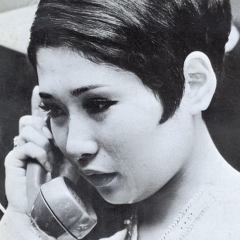

“If we were someplace else I’d punch you in your goddamn nose.” — Bob Dylan’s manager Albert Grossman to hotel manager
The 1960s saw some great music documentaries, like Gimme Shelter, Monterey Pop, and D. A. Pennebaker’s venerated classic covering Bob Dylan’s 1965 U.K. tour, Dont Look Back (sic). The intro sequence, with “Subterranean Homesick Blues” playing and Dylan dropping cue cards has been copied and parodied so many times that people have often seen the references before the referenced. By 1967, this song could almost be seen as Dylan nostalgia, so fast was his trajectory into and through the other side of the rock scene; at the time of its shooting, it was likely a sly dig at the folkies, flaunting his new noisy aesthetic that would come to define much of his middle career. The then-recently-released 7″ single “S.H.B.” hangs heavy in the air throughout the entire film, a harbinger of what was to come. Teenage girls complain to him and Dylan shoots back with “Oh, you’re that type, I get it,” before kindly reframing with “But I like to play with my friends…You don’t mind if my friends play on my record, do you?” Today, it is impossible for us to comprehend what an alien sounding and oddly structured song this was for fans accustomed to “Blowin’ in the Wind” or “The Times They Are a-Changin’.” Although these were recorded just a couple of years prior and can be heard on car radios throughout the film, promoting his concert appearances, Dylan is so clearly bored with these tunes while performing live that he flies through them at fast tempos. They seem like necessary obligations en route to the new introspection of “It’s All Right, Ma (I’m Only Bleeding),” “Gates of Eden,” and “Mr. Tambourine Man.”
Dylan is so canonized within American popular culture today, it is important to remember his place in music in 1965, when he continued the process of stepping away from a folk scene that he had outgrown creatively but which still clung to him as their conduit into the semi-mainstream. The first small step can be seen in 1964’s Another Side of Bob Dylan, where he abandoned politics for poetics while keeping the acoustic aesthetic completely intact. At the time of this tour Bringing It All Back Home had just been released, which saw Dylan split literally in half: Side 1, electric; Side 2, acoustic. The next album, Highway 61 Revisited, would see him take the full electric plunge. It was a huge artistic gamble, tossing away an entire folk fanbase that loved and supported him for a rock scene that knew nothing of his music, only that he was some Woody Guthrie wannabe in a train conductor’s hat. It’s worth bearing in mind that Dylan could have very easily fallen on his face and ended up a mockery, rejected by both audiences.
Pennebaker’s grainy, unpolished film captured a musician at work like no one had ever seen before: goading on reporters; playing Hank Williams in his hotel room; being an arrogant dick for cameras; looking exhausted and sometimes bored. Some of the confrontation scenes themselves are now classics of pop culture, referred to in such dorkville shorthand as “The Science Student,” “The High Sheriff’s Lady,” and “Small Cats Want to Come at Me!“ It is incredible to think that by the time Dont Look Back saw its 1967 theatrical release, Dylan was done. He had conquered electric, brought pretentions of french romanticism to rock lyrics, and toured heckler crowds with the The Hawks in tow. Pennebaker was there to film that too, through Europe in 1966. The final product, never officially released but known as Eat the Document by generations of bootleggers, was dark, depressing, and pretty unwatchable. In it, drastically underweight and strung-out on amphetamines and heroin, one sees very clearly the end that was fast approaching; and it’s probably sheer luck that Bob Dylan didn’t end up on the roster along with Jimi Hendrix, Janis Joplin, Brian Jones, and Jim Morrison. After the tour, Dylan supposedly had a motorcycle wreck in the woods that nearly broke his neck. The “crash”–physical, chemical, or both–became a sort of K-Pg boundary for his entire career, a romanticized extinction line of the “thin white mercury sound” soon replaced by a cornball Appalachian folksiness. Although this “Basement Tape” period is now sacrosanct in boomer rock culture, many Dylan fans at the time mocked and derided the move. His newfound embracement of Zionist Israel, who had just invaded and occupied Palestine in 1967 to world condemnation, pushed left radicals even further away, as did his total silence on America’s invasion of South Vietnam and its bombings of Cambodia and Laos. At 30, he was already an establishment has-been, releasing bland albums like Self Portrait and New Morning, both of which A.J. Weberman famously lambasted in his secretly taped phone conversation from 1970, heavily bootlegged on cassette and later released on vinyl in 1977 on Folkways. After Weberman mocks the lyrics of “Sign on the Window”, Dylan loses it: “Hey man, name me one person that writes better songs than I do!…You can’t, you know you can’t!” As he rattles off names and Dylan shoots them down, he does finally concede that George Harrison and Gordon Lightfoot “aren’t bad.” A.J. calls him a fucking capitalist pig that produces music instead of guns. “Hey, that’s something,” Dylan asserts in his defense. “Yeah, but lately it’s nothing,” Weberman responds.
 Center For Cassette Studies