Author: Center For Cassette Studies

Arresting Power

Keaton-2-r45369

Portland might be at the forefront of progressive composting, but in terms of racism and police violence against people of color, it is no different than any other urban center in America. The incredible documentary Arresting Power begins with an excruciating play-by-play of the 911 calls leading up to the murder of Aaron Campbell, who, feared suicidal by his family after the death of his brother, was shot and killed as he attempted to defend himself from a police dog attack. It is only the beginning of a long string of examples, some discussed in depth (Kendra Jade, Rickie Johnson, Tony Stevenson, Keaton Otis), others noted in passing between sections, but all where police killed and attempted to justify the use of their excessive violence. As Walidah Imarisha has explored in her examination of Oregon’s racist beginnings, the state was founded as a white refuge and has a long history of exploiting minorities for labor, while not allowing them to settle permanently. The notorious Lash Law was technically on the books until 2001. In the 1920s, Oregon also had the highest per capita membership of the KKK in the nation (approximately 14,000).

In the wake of systemic police violence in Albina, a group of black activists in north Portland founded the NCCF, the National Committee to Combat Fascism, in 1967. Members of this organization (Kent Ford, Percy Hampton) went on to spearhead the Portland chapter of the Black Panther Party. Like the Oakland and Chicago chapters of the BPP, they emphasized community empowerment, self-sufficiency, and public safety within the black community, starting breakfast programs at Highland Community Church and a free health clinic on North Russell, named after Chicago BPP chairman Fred Hampton. The historical incidences described are beyond belief, but the unjustified killings all follow typical patterns of police violence: claims of non-existent weapons, fleeing black “suspects” defined as “threats”, racial profiling and the absolute debasement and lack of concern among white people in authority for black people’s lives. Great sets of interviews with Joann Hardesty (Albina Ministerial Alliance Coalition for Justice & Police Reform) and non-violent protesters attacked and arrested by police during marches for Kendra Jade in 2003 reflect a culture of intimidation and violence used to squelch public dissent.

The directors–Jodi Darby, Julie Perini, Erin Yanke–scratch 16mm film at the sites of the killings just as graphite rubbings are made from gravestones. These segments are used as segues, with names of the victims shown on screen. It is an unsettling and effective method of respectfully acknowledging a list of names so abhorrently long that no single documentary could adequately cover each story and give redress to the social injustices reflected in each. The fact that filmmakers would have to pick and choose from such a long list of “justified” killings is telling and only reinforces the fact that Portland is more concerned with fulfilling the state’s historical dreams of white capitalist enclave and gentrified hi-tech playground than investing in our increasingly displaced and struggling communities of color.

Hearts and Minds

heartsh

“For twelve centuries we fought against China. For 100 years we fought the French. Then came the American invasion–500,000 of them–and it became a war of genocide.” — Father Chan Tin

“The Oriental doesn’t put the same high price on life as does a Westerner. Life is cheap in the Orient.” — General William Westmoreland

Throughout the late 70s-80s, Vietnam became the focal point for a broad range of American films, some dealing with combat (Platoon, Full Metal Jacket), some with aftermath (Deer Hunter, Coming Home, Born On the Fourth of July), others using it as a setting for adaptations (Apocalypse Now as Conrad’s Heart of Darkness). Then there was the deluge of POW films from 1983-86, with even Gene Hackman (Uncommon Valor) getting on the solider-of-fortune vigilante bandwagon. Within Reagan’s creepy and bankrupt culture of nationalism, the Vietnam “Prisoner of War” movement went into overdrive, fueled by a fervent anti-Communism permeating the mass media of 1984, the year of Reagan’s re-election. Newt Heisley’s flag image, created in the early 1970s, was suddenly plastered everywhere. In the midst of this, and perhaps as a reaction against it, new documentary forms were taking shape. These new filmmakers were social activists and balked at the notion of a so-called “balance” that they were constantly being accused of lacking. The first was Rafferty-Loader’s Atomic Cafe in 1982, an examination of Cold War hysteria told through an incredible collage of newsreels, educational films, and other “duck and cover” pop culture. The second was Michael Moore’s Roger & Me in 1989, his swan song to Ford and Flint. But both owe much to an earlier, lesser-known 1974 film that Moore has called “not only the best documentary I have ever seen, but maybe the best movie ever.” That film is Peter Davis’s Hearts & Minds.

The impact of the Vietnam War on U.S. policy is well known: it made conscription unsustainable, drafted soldiers being too much of a liability both on the battlefield and once returned home. Reagan’s administration realized indigenous mercenaries like the Contras could be financed, armed, and trained to terrorize their own pro-democratic activists without working-class American youth getting their hands dirty. Until the 1989 U.S. invasion of Panama, things went totally underground for the better part of a decade, public reaction to Vietnam being a prime reason for this shift in intervention. But until coming across Hearts & Minds, I had never seen Vietnamese citizens themselves speaking about what this war wasn’t (a fight against Communism) and was (the apex of an ongoing Western colonial war of genocide against a people fighting for independence and national unification.) Nor had I heard the view articulated so well by former-Sgt. William Marshall, who lost an arm and a leg and was furious for what his country had drafted him to do in the name of, well, access to markets and natural resources. In many ways, it reminds me of Studs Terkel’s book “The Good War”: An Oral History of World War II, which serves as a compendium of human experiences across the board, the quotations around “good war” intentionally ironic. In the same vein, Hearts & Minds could be nested in the same, this being the warm-and-cuddly Lyndon Johnson phrase used to discuss what needed to be done for victory.

The film, shot just as the war was winding down, is a fast-paced compilation of interviews without narration. This was a very rare approach for a documentary on war. Newsreel style was still the norm; think the BBC’s World at War series and Laurence Olivier’s refined narration. By contrast, Hearts & Minds was honest and matter-of-fact, attempting to soften the conflict for no one. It reminds the viewer that war is also about human remembrance and raw emotional experience, not large tactical arrows outlining which division went where and why. The participants run the gamut to policy makers to people on the street, both in America and Vietnam. Infamous “hawks” like Kennedy-aide Walt Rostow openly belittle and insult Davis when he asks for an honest accounting of the conflict’s origins, saying that rehashing that is “pretty goddamn pedestrian stuff at this stage of the game.” He is but one of several who openly assume that their version of the war is the only one in existence, the only one that matters, the only one scholars need concern themselves with for the historical record. Luckily, there are interviews with Daniel Ellsberg (leaker of the Pentagon Papers), Barton Osborn (CIA agent who quit and blew the whistle on covert operations), and a host of others who tossed their bureaucratic careers aside to speak out against the injustice they’d helped to sustain in some way. Alongside these are the stories of two U.S. servicemen: Randy Floyd, an air force pilot who flew 98 bombing missions; and Lt. George Coker, a returning POW who had just spent the majority of the war in captivity. Through great editing, their own perspectives unfold gradually, scene by scene, as do those of dozens of others, like Detroit-born William Marshall, and peace-activist Bobby Muller, who would go on to found the Vietnam Veterans of America.

Most intense are the scenes with the Vietnamese, all of whom spoke up despite very real dangers for doing so (the war was still going on during early filming.) There are the victims: the coffin maker, who looks over his shoulder while speaking; the two sisters, whose prolonged silence and sadness at the end of the scene pushes an intensity onto the viewer which is almost unbearable; the Catholic and the Buddhist, both aligned in their views on the Vietnamese struggle for independence; the angry, grieving father who demands an explanation of what he had ever done to Nixon for him to come there and murder his family; the man who says to a friend, after looking at the camera, “Look, they’re focusing on us now. First they bomb as much as they please, then they film.” Then, there is the lavish country club banquet of the South Vietnamese capitalist class, the recipients of the billions in American foreign aid pouring in, one of which makes the incredible admission that “We saw that peace was coming, whether we liked it or not.” The comment is astounding, delivered without a pause, and really says it all. U.S. corporations can be seen encroaching throughout Saigon: Sprite trucks, Coca-Cola plants, toothpaste billboards with smiling Western women, even the ridiculously out of place Bank of America. Eerily, CBS logos, intended to be a “ubiquitous eye that is watching all”, are ordered left on the bodies of Vietcong corpses by soldiers in the field as an ominous calling card.

In the end, what is so relevant and sad about Hearts & Minds today is the fact that little has changed. The fabrications for foreign invasion by American policy makers continues. Consecutive administrations still lie to keep up some modicum of popular support. The jingoistic hysteria following 9/11 was nothing new, nor was the xenophobic nationalism that accompanied it. Even General Westmoreland’s racist quote has now been uttered in a thousand variations over the past ten years, just replace “Oriental” with “Muslim.” But perhaps most telling are the prescient closing words of ex-bomber pilot and activist Randy Floyd when asked what was learned from it all: “Nothing. The military doesn’t realize that people fighting for their freedom are not going to be stopped by changing your tactics, by adding more sophisticated knowledge. Americans have worked extremely hard not to see the criminality that their officials and their power makers have exhibited.”

Incident at Oglala

wounded-knecamp-ap

“We’re trying to regain what we had in the past, being human beings and being involved in human society.” – Stan Holder, Wichita AIM leader

During the height of its power and influence, the Black Panther Party was an important symbol to other oppressed people of color, both at home and abroad. Among these was AIM, the American Indian Movement, a group of radical Native American activists who drew inspiration from the BPP’s program of zero tolerance for America’s authoritarian power structures. Like the BPP, AIM had no shortage of historical grievances to add to its agenda. One of their earliest actions, in 1972, was partnering with other indigenous rights groups from the U.S. and Canada to trek cross-country, from California to Washington, D.C., in the Trail of Broken Treaties. Once there, Nixon refused to meet with them or acknowledge their lengthy list of demands but the protest established AIM as an important new grassroots movement and caught the FBI’s attention. It’s widely believed that the FBI did not discontinue their counterintelligence program following the outing of their murder of BPP leader Fred Hampton in Chicago. In fact, there is plenty of evidence to support the contention, made by Russell Means, Dennis Banks, Ward Churchill, and others in AIM, that the FBI ran the exact same counterintelligence program of informants, disinformation, and “bad jacketing” against the American Indian Movement, tactics employed with such effectiveness against the Black Panther Party in the years prior.

Corruption on reservations was first and foremost on AIM’s agenda. In the lead-up to the most famous AIM occupation, they accused the Bureau of Indian Affairs (BIA) of inciting violence and fostering an atmosphere of intimidation and fear on the Pine Ridge reservation as a means of social control, further asserting that this was all done in collusion with the FBI, whose agenda was the splintering and eradication of all radical minority organizations. There was a failed procedural attempt at removing the corrupt head of the BIA, Dick Wilson, who was believed to be responsible for many murders and mysterious disappearances at Pine Ridge, with the help of his security forces. Just like with the BPP takedown by the Chicago police, the BIA–specifically Dick Wilson and his self-proclaimed GOONs (“Guardians of the Oglala Nation”)–became the triggermen for the FBI, working to undermine and destroy efforts of indigenous independence and solidarity.

Things came to a head on February 27, 1973 with the famous Wounded Knee occupation.

Incident at Oglala was the first (and only) mainstream documentary dealing with Native American radicalism in the 1970s. Its scope is focused primarily on the 1973 Wounded Knee occupation and the subsequent case of AIM-member Leonard Peltier and his alleged (and highly contested) involvement in the murder of two FBI agents injured and then killed execution-style in a firefight on Pine Ridge, a case for which he is still serving a life sentence in Canada.

The Murder of Fred Hampton

bannerer03fred2-20060301

Last week’s screening Black Power Mixtape provided an overview of some key players in the black power movement. This week, we will look specifically at the murder of two black activists by the State and the coordinated collusion between the FBI and the Chicago Police Dept. to eradicate the Chicago arm of the Black Panther Party through terror and violence.

On the night of March 8 1971, a handful of activists calling themselves the Citizens’ Commission to Investigate the FBI broke into the federal offices in Pennsylvania and raided file cabinets. The stolen documents they obtained confirmed earlier suspicions of how far the FBI was willing to go to infiltrate and destroy domestic organizations dedicated to issues of human rights and social justice. The FBI’s program went by the name COINTELPRO (for Counter Intelligence Program), and its main target was the Black Panther Party, which it deemed a terrorist organization and a threat to national security due to its calls for black empowerment and especially its anti-capitalism. The FBI used false communications, agent provocateurs, and, with the aid of local law enforcement, assassination to splinter and destroy the organization.

The Chicago chairman of the BPP was Fred Hampton, a charismatic leader whose first arrest in 1968 was for stealing $71 in ice cream and delivering it to children in the neighborhood. Above all, Hampton was a brilliant networker and speaker, a builder of bridges between groups with like social agendas, however tangential. Even among South Side’s apolitical gangs, he worked hard to push the Party’s message of empowerment and community control and actively sought their solidarity and support. Like the BPP more broadly, he saw Socialism as the only answer for working black people in America and championed international unity among oppressed people of color, promising solidarity with any group, black or white, that would align themselves with the BPP’s ideals of transnational liberation for all suffering under capitalism and colonialism.

The FBI decided Fred Hampton had to go. The State would not tolerate a supreme teacher in the mold of OAAU-era Malcolm X, delivering radical messages of global outreach and racial unity that transcend religious divides. Through a manipulative quid pro quo, they pressured a 19-year-old black man earlier arrested for car theft to act as an informant; William O’Neal gained access to the BPP’s brownstone headquarters and, even more effectively, became head of security and Hampton’s bodyguard. He provided floorplans of the apartment and flagged the location of Hampton’s bedroom.

On December 4, 1969, at 4:30 am, there was a knock on the door of the BPP apartment. Mark Clark, on security watch and armed, walked to the door and asked, without opening, who it was. “It’s Tommy,” a voice said. “Tommy who?” Clark asked. “Tommy gun” came the prearranged cue. Through the door, Mark Clark was shot in the heart and died instantly. As he body convulsed, he pulled the trigger of the gun he was holding as the Chicago Police fired 90 rounds into the apartment. Fred Hampton, who had been drugged earlier by informant O’Neal and possibly never regained consciousness, was badly injured on the mattress in his bedroom; a later autopsy showed that he was killed from two shots fired into his skull at close range, finished off by the cops once inside, who were overheard saying “He’s good and dead now.” With their main target dead, they continued to fire into the other rooms, later charging all of those shot and injured with attempted murder, including Deborah Johnson, Hampton’s 8-mo-pregnant fiancee.

Despite the falsified ballistics tests, Mark Clark’s reflex shot was the only bullet fired by the BPP. Hence, there was no “wild firefight” as reported by the Chicago Police, who quickly held press conferences to laud the great achievements of their officers and proclaim the community safe from the militancy of the Panthers and their dangerous breakfast program for children. Within hours of the assault, the Panthers called in the film crew who had been filming Hampton’s speaking engagements. This team began to make a documentary quite unlike the one they started out to shoot. Their footage, which contradicted accounts given by the CPD and FBI, would further open up massive holes and inconsistencies in the State’s official version of events. Crucially, the Panthers also opened up the crime scene to the public, and over 25,000 Chicagoans filed through to see the blood-stained execution space for themselves, to see the nails in the wall the CPD attempted to falsify as bullet slugs fired from BPP guns. The Chicago Tribune, initially supportive of the police’s version of events, changed their coverage when the amount of contradictory evidence became clear, and their reporting added to the damning documentation already gathered by the BPP and the photographic evidence taken by the filmmakers.

The civil case would drag on until 1982, as the FBI and CPD worked hard to stall the proceedings of the Hampton and Clark families. Two FBI documents obtained in that 1971 classified file theft, including O’Neal’s map of the apartment, revealed his role, and the feds involvement and attempted cover up. In the end, “justice” (if one could call it that) prevailed in the form of a monetary settlement of 2 million. None of the police officers, nor Cook County/State’s Attorney Edward Hanrahan, and obviously none of the FBI agents, were ever indicted in the murders. The ensuing public scandal did cut short Hanrahan’s political ambitions and facilitated increased black activism within the city, but the Chicago BPP never fully recovered from the blow. It says volumes about America’s political class and the mainstream media’s subservience to it that Watergate became the historic benchmark for the abuse of State power and not COINTELPRO. It seems the state-sanctioned murder of leftist black activists always takes a backseat to hotel break-ins and tape recordings if the political elite are the ones being wiretapped.

I would never say that Fred Hampton is currently in the national spotlight because he is a revolutionary person of color buried and obscured by the white power structures of our nation, his execution a footnote at best within our so-called institutions of higher learning. But the number of times I have seen this documentary and this case mentioned over social media in the past 12 months is more than I have seen in the past 20+ years combined. A new generation of people of color are keeping Hampton’s memory and message alive, screening this documentary in communities, engaging in important conversations, and exposing the continuum of white supremacy and violence that is still a hallmark of American capitalism.
Black Power Mixtape

BLACK POWER MIX 1hlow-splsh

Ever since capitalism was forced to shift from slavery to wage exploitation, it has attempted to co-opt and control people of color on a global scale by various means. More often than not, this takes the form of state violence and coercion, and, at least since 1945, the U.S.A. has taken the global lead in this role. Whether targeting domestic radicals at home or indigenous “populists” abroad, who have the audacity to refuse the relinquishing of their material resources for western use, the United States abysmal postwar record is clear. Numbers vary (often because we don’t bother to count), but in Vietnam’s war for independence against western colonialism, it’s now estimated that we murdered around 1,700,000 Vietnamese between 1965 and 1974 (British Medical Journal study, 2008); and that doesn’t take into account the French period back to 1955. Our record in Latin America, the Middle East, and Africa from the 1970s until today speaks for itself, and the violence perpetrated among people of color within our own borders has often been called an internal extension of our nation’s external behavior against the southern hemisphere. Throughout social media, the core tenets of white capitalism are now being called on the carpet daily by those it most exploits. The Black Lives Matter movement, like the Black Panther Party before it, is a pivotal moment in the ongoing struggle for social justice in America. It disregards the “rogue cop” fallacy and pushes issues of police violence further by questioning the processes and the policies. While demanding accountability for the murderers, activists go further and point out that these “bad apples” are in fact working as intended, protecting the broader aims of institutionalized capitalism by killing members of a black underclass whose “loosies” somehow challenge the profit margins of U.S. corporations. For this spring’s lineup, Watzek Screens has selected six films covering revolutionary struggle by people of color against capitalist authoritarianism and state violence. Films will cover the Black Panther Party and the FBI’s assassination of BPP members Hampton and Clark, the American Indian Movement’s Wounded Knee occupation at Pine Ridge, and international films on FLN’s fight against the French in Algeria and Vietnam’s war against U.S. dominance. We will end with Arresting Power, the recent documentary on historical police violence against the black community in north Portland.

There really is no single pivotal moment within the Civil Rights movement that led to its ideological diffusion. It was a gradual process throughout the mid-to-late 60s, the culmination of increasing white violence in the face of black non-violence, including the murder of key figureheads MLK and Malcolm X under suspicious circumstances. Although government ties to each have long been debated, hard evidence is lacking, apart from admitted CIA surveillance activities and attempts to actively discredit King with smear tactics. Self-defense, empowerment, and black pride became the new rallying cry for those tired of the absolutism of non-violence.

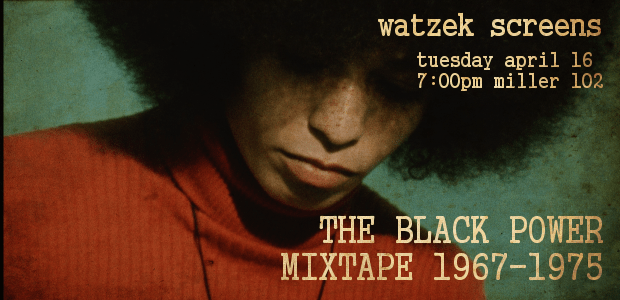
In the late 1960s, a group of Swedish filmmakers came to the United States to document this nascent black power movement. For whatever reason, the footage they shot ended up unlabeled and forgotten in a Swedish Public Television vault for thirty years, until it was reassembled and released in 2011 as The Black Power Mixtape 1967-75. Its structure is loose by design, allowing large spaces for black activists to speak in their own words, with narration and readings of select texts provided by The Last Poets’ Abiodun Oyewole. A centerpiece is an interview with BPP-member Angela Davis, then imprisoned in California in 1971 on trumped-up, 1st-degree-murder charges for the death of Judge Harold Haley, a charge for which she was later proven not guilty. Like Malcolm X before them, Davis and other Panthers fostered a solidarity between people of color movements worldwide, particularly in Algeria, Angola, and Vietnam. While placing their own struggles squarely within the context of capitalist exploitation of black Americans, they nevertheless made broader connections with fellow victims of imperialism abroad by supporting, however possible, subaltern societies of the global South who had zero voice (at least in the North) and who were suffering horribly under carpet bombing and chemical defoliation.

Mixtape shows the players speaking for themselves in both text and image. Next week’s The Murder of Fred Hampton will get at the heart of the matter, at what can happen to a motivated, charismatic revolutionary of color who works to galvanize an impoverished urban black community around issues of social justice, white violence, and capitalism.

Repo Man

repoTORJ2

“Go West, young man, go West. There is health in the country, and room away from our crowds of idlers and imbeciles.” — Horace Greeley, 1833.

“There’s fuckin’ room to move as a fry cook. I could be manager in two years. King. God.” — Zander Schloss in Repo Man.

How Alex Cox, only 29 and fresh from UCLA film school, ever got Repo Man released and distributed by Universal Studios is a bit of a mystery. Perhaps they felt like there was enough spark left in the then-fading punk LA subculture to sustain a shoestring film shot on just $160,000, or at least to break even on such a gamble. It was, of course, the first big leading role for Emilio Estevez, whose Otto was the epitome of directionless, disenfranchised Reaganomics, and the polar opposite of the disappointing “humanistic jock” he became in the following year’s The Breakfast Club. The two films are worth comparing, not because of Estevez’s involvement, but because of how they embody different takes on teen narratives. Hughes could not avoid the maudlin. Characters must succumb to fits of melancholic introspection where they outline the pain and anguish of their young lives, ultimately highlighting the common bonds that draw them together in doing so. Repo Man was a different kind of teen film, showing the dreary, non-glamorous side of Los Angeles and roping in a pending apocalypse, alien subplots sans aliens, and Harry Dean Stanton. It was anarchy. And it sent a clear message to a cadre of young filmmakers, like Richard Linklater, that teary exposition and epiphany is not always the best path for youth in film. Sometimes its better to dish exposition on social mobility options within the fast food industry and leave it at that.

Today, Alex Cox is probably best known for 1986’s Sid & Nancy, the bio-pic on late Sex Pistols bass player Sid Vicious and his alleged murder of girlfriend Nancy Spungeon, which, like Estevez in Repo Man, would launch Gary Oldman’s Hollywood career. Sid & Nancy, although sparking debates within the underground music scene at the time of its release, has aged pretty good; the issues that people had with it–primarily factual stuff and goofy stereotypes of the London punk scene–are today moot points, as these histories have been documented dozens of times over the ensuing decades, by both participants and researchers. Cox’s films have always been connected, in varying degrees, with music subculture. Repo Man is a particularly striking example. It premiered to critical raves but due to overall public indifference and confusion closed within two weeks. The soundtrack, however, sparked just enough sales and charted just high enough for Universal to reconsider their decision. But it wasn’t the re-release that gave Repo Man its longevity; it was the nascent-but-exploding market of VHS that really circulated the film where it needed to go, that made it passable from friend to friend, either literally or word-of-mouth recommendations. It was one of the first films whose primary success rested on its VHS reputation alone. By the late 1980s, Repo Man would be acknowledged as the best indie film of the decade, its use of irony and pot shots at everything from dying California hippy culture to dead end jobs making it a clear forerunner to later (and lesser) films like Napoleon Dynamite.

Polyester

polyester

Director John Waters in conversation with Mike Kelley, “The Dirty Boys”, Grand Street, No. 57, Summer 1996:

Waters:  Do you understand how you have computer sex?  I don’t.

Kelley:  I know people who do that.  You get into these chat groups.

Waters:  So, it’s like phone sex, only you type?

Kelley:  You can do a lot more pretending; like you can pretend to be the opposite sex, and the other person doesn’t know.

Waters:  Phone sex I get.  But how do you act butch on a computer?  Do you misspell?  Do you write in bad English?

Kelley:  Yeah, I guess so.  “My warge hands, dese hands, they weach out for youse.”  I don’t know. 

With our nation’s humor now stranded in the doldrums of irony, it is difficult to remember a time when it was not so, when neither cross-dressing nor foot fetishes were part of our popular lexicon. But in 1981, things were very different. It was the year that accidentally-hilarious melodramas like Mommie Dearest and Endless Love raked in millions of dollars and derailed the careers of Faye Dunaway and Brooke Shields, respectively (while both films made inroads into the gay community for reasons wholly unintended). Arthur was the biggest grossing comedy. And John Waters’s film Polyester, well, it didn’t really register, even as it saw Waters shift ever so slightly towards a more mainstream look and feel, a transition that would lead to his breakthrough Hairspray by decade’s end, a film that launched Rikki Lake’s career and, sadly, was Divine’s early exit at just age 42.

Polyester is, of course, best known for its “Odorama” gimmick, where scratch and sniff cards were distributed to filmgoers upon entering the cinema. This was a nod towards the 1950s gimmicks popularized by filmmakers/hucksters like William Castle, whose ridiculous onscreen “Fright Break” timer in the thriller Homicidal Waters remembers fondly:

“Castle simply went nuts. He came up with ‘Coward’s Corner,’ a yellow cardboard booth, manned by a bewildered theater employee in the lobby. When the Fright Break was announced, and you found that you couldn’t take it anymore, you had to leave your seat and, in front of the entire audience, follow yellow footsteps up the aisle, bathed in a yellow light. Before you reached Coward’s Corner, you crossed yellow lines with the stenciled message: ‘Cowards Keep Walking.’ You passed a nurse (in a yellow uniform?…I wonder), who would offer a blood-pressure test. All the while a recording was blaring, “‘Watch the chicken! Watch him shiver in Coward’s Corner’!” As the audience howled, you had to go through one final indignity – at Coward’s Corner you were forced to sign a yellow card stating, ‘I am a bona fide coward.'”

While “Odorama” wasn’t quite as inspired or elaborate, the viewer saw a number on the screen, scratched the appropriate circle, and received anything from airplane glue to roses to dirty feet to new car smell. Among many vaguely familiar with his work, John Waters is best known for his long association with childhood friend, fellow homosexual and drag queen extraordinaire Divine (a.k.a. Glenn Milstead.) Both grew up in Baltimore and maintained a love/hate relationship with the city, the hate manifesting itself comically in Waters’s great gift for parody and satire. Polyester is first and foremost a brilliant manic send-up of the “women’s picture” genre of the 1950s-60s best exemplified in the works of directors like Douglas Sirk (Imitation of Life, Written on the Wind, Magnificent Obsession), films that both Waters and Divine grew up watching, and with which the LGBT community has always held in fascination, reworking the subtext to fit their own world views. Other gay directors, like Ranier Fassbinder, would create contemporary versions of these classics in other languages, like his Ali: Fear Eats the Soul, while directors like Waters projected these melodramatic plots through their own warped filters of suburban Baltimore, where his biggest goal as a rebellious child of Catholicism was to own a porno theater. In a sense, he achieves said goal, as he makes good use of both smut peddlers and Catholic sisters here.

Like all good modernist melodrama from the Sirk period, the lead is a woman, only it’s Divine in drag, who is called Francine Fishpaw, an unhappy alcoholic who fantasizes about escape. In one of the most masterful casting decisions of all time, Waters hired former teen heartthrob (and gay icon) Tab Hunter to play the lustful middle-aged object of Francine’s affection. Tab Hunter, while not officially out at the time, was long rumored to have been homosexual, although the studio’s publicity departments had once worked overtime to connect him romantically to fellow teen stars like Natalie Wood. By 1981, as far as traditional Hollywood was concerned, his career was pretty much dead in the water, and for him to embrace Waters’s vision while mocking his own beefcake status was an inspired and wise career move on his part. But through the course of its 90 minutes, Waters takes aim at everything in this film, from marriage, to abortion, to sexual fetishes, to nuns on hayrides. His cast of non-professionals (and professionals who are hilariously overacting) only lend to its awkward aesthetic of an after-school teen television special gone horribly, well, drunk.

The Decline of Western Civilization

declineTORJ2

“A guy loses his temper on the set and he’s a genius. A woman loses her temper on the set and it’s the wrong time of the month.”  — Penelope Spheeris

The 1980s occupy a weird spot on our cultural landscape. Things that seemed important are almost completely forgotten; what seemed irrelevant, now sacrosanct. We have nostalgic longings for those micro-expressions of identity conveyed so meticulously through analog “mixed tape” culture, where hours were spent picking strong lead-ins and balanced transitions that said something profound(ish) about your sonic relationship to friends. Around the late 80s, terms like “alternative” and “postmodern” gained ground and became shorthand for lazy journalists who knew nothing about the music scene but needed a quick, generalized descriptor. As for film, it was way worse. The 70s staple of “art house” was typically used but made little sense. If using “underground,” your work often got lumped in with exploitation films and softcore porn. Such was the cultural landscape when young filmmaker Penelope Spheeris shot her gritty landmark documentary on the Los Angeles hardcore/punk scene, The Decline of Western Civilization.

It’s safe to say that Spheeris would agree with the old maxim about getting the highest financial return on your least fulfilling work. Many screenwriters, actors, and directors have talked of being rewarded well for their mediocrity (if that mediocrity sells), then using that money to finance risky projects that speak to them in some deeper, more profound sense, a sense divorced from the realities of the entertainment marketplace. By her own admission, today Spheeris would fall into this category, relying on the profits from her huge formulaic Hollywood films to pay for the work she loves doing. But Decline was her fist-feature film, and she did not yet have that luxury. Instead of the porn venture they were hoping for, she convinced a couple of San Fernando Valley producers to take a chance on investing in a documentary about the booming underground hardcore music scene then happening in and around Los Angeles. Although getting them literally no return, it was a fortuitous investment, artistically speaking, as many of these bands would, despite their brief existence and zero mainstream notoriety, later be regarded as the vanguard of the American independent music scene. Although there have been several contemporary documentaries that, to varying degrees, canonize the 80s hardcore movement, Decline stands as a primary cultural document of L.A.’s punk subculture. Some criticism has been leveled at it over the years, not without reason. But Spheeris walks an impressive line between identifying with the scene, respecting its collectivism and revolutionary spirit, while also displaying its dirty laundry, its ignorance, racism, sexism, and homophobia. Since its earliest origins in Britain, as part of its fuck-you arsenal, early punks had used Nazi iconography like the Swastika or Iron Cross (first sported by Detroit’s Ron Asheton of the Stooges as a choker) to incense the older generation, and to some extent this trend continued in the U.S., despite some bands’ efforts at mocking or undermining fascist ideals in their songs. But while Black Flag got the irony of their Puerto Rican lead singer performing “White Minority,” I’m not so sure some of their fanbase understood the finer points of such satirical moves. In a 2013 interview with The Guardian, artist Raymond Pettibon, whose album and flyer art epitomized L.A. hardcore, remarked on the negative aspects of the scene:

“It was more about what you can’t do than what you can do. There were restrictions. Any intellectual curiosity was discouraged. Any humor was discouraged. ‘Don’t learn another chord’… You had to pretend to be a moron, basically. I mean, Sid Vicious was the most important intellectual figure…”

Pettibon’s comments highlight a problem exemplified several times throughout the film. World views of some bands (when loosely expressed) did not correlate with those of the fans, many of whom were coming in from L.A.’s suburbs and carried with them a different set of life experiences. Bands like X and Circle Jerks held more liberal viewpoints, while others that did not make it into the film, like The Minutemen, were pretty much straight working-class Marxists. Other key political bands from California, like San Francisco-based Dead Kennedys, are entirely absent as well. Perhaps part of this is due to Spheeris’s timing. After Ronald Reagan won the Presidency in 1980, the scene grew more outspoken and political as it galvanized around a common foe, especially the D.C. hardcore scene, with bands like Minor Threat. But the D.C. scene was vastly different, just as those of Portland, Boston, and Austin assumed the cultural proclivities of their surrounding parent cultures. As for L.A.’s parent culture, its mythos is a binary narrative, of success or failure, of making it big or not, and its punk scene embraced the pessimistic dystopian flip-side of Hollywood’s fantasy utopia, while avoiding the articulation of any viable alternative.

The scene would not last long, imploding by the mid 80s as hardcore morphed into various sub-movements and the emergence of college radio and the proliferation of zine distribution offered those bored with the mainstream a broad range of diverse sounds from every region of the country. Due to several high-profile cases–particularly, it should be noted, the 1988 “East Side White Pride” beating death of Ethiopian student Mulugeta Seraw here in southeast Portland–hardcore gradually became synonymous with the White Aryan Resistance skinhead movement. Americans didn’t care about the philosophical nuances between the historic leftist working-class “Oi!” skins and the Nazi-fetishizing psychopaths. If you had a shaved head, wore combat boots, and liked music with so many beats-per-minute, you were a skinhead and dangerous; and that probably killed the scene faster than anything (well, that and Lee Ving being in Clue). It would take the popular acceptance of grunge, when bands like Nirvana cited Black Flag and Wipers as key influences on their craft, for U.S. hardcore/postpunk to shed the Aryan white-power associations that it had, in many ways, created by its own shock tactics.

Pierrot Le Fou

PIERROTRJ52

“In my other films, when I had a problem, I asked myself what Hitchcock would have done in my place. While making Pierrot, I had the impression that he wouldn’t have known how to answer, other than ‘Work it out for yourself.'” — Godard

As the 1960s became politicized, so did sectors of the French New Wave. The artistic philosophies that once united the directors into a common cause began to collapse. In the wake of the Paris protest riots of 1968, their ideological assertion from ten years prior, that the true aesthetics of film art transcended politics, was quaint and hilariously naïve. Cahiers du Cinema became a platform for extremist Marxism and drew hard, red lines in the sand, questioning the allegiances of all directors and asking what they were doing for the “movement.” Even the magazine’s founding fathers Truffaut and Rohmer were not spared its editorial ire, despite the former’s public stand against colonial French involvement in Algeria. The only director to sometimes get a pass was Jean-Luc Godard, starting with Pierrot le Fou.

At the tangential heart of Pierrot le Fou is a genre that meant much to Godard and the entire French New Wave: the crime story, particularly film noir and the American hardboiled literature that gave rise to that movement. Although on the fringes in their home culture, crime writers such as Horace McCoy, Jim Thompson, and James Cain were nothing short of rock stars in postwar France, whose literati championed their works as existentialist masterpieces, using lowly populist genre fiction to assert broader truths about the human condition. Truffaut’s second film, Shoot the Piano Player, was based on a novel by Philadelphia-born David Goodis, and one could point to Louis Malle’s Elevator to the Gallows as arguably the perfect distilment of noir and street. Godard had, by the time of shooting Pierrot le Fou, mined the crime genre extensively with BreathlessBand of Outsiders, and Alphaville. He now set out to shoot Lionel White’s 1962 novel Obsession. To be fair, Godard was never very kind to the authors whose works he chose to adapt. Even when he stuck extremely close to the source narrative, like in Contempt, he publicly described Alberto Moravia’s novel as a “nice, vulgar one for a train journey, full of old-fashioned sentiments.” As for the affectations of the crime genre, he had always been liberal with his interpretations and unafraid to toss convention aside whenever it bored him. One week before shooting began, he realized that he no longer cared for the story and even less about telling a crime tale. It was his moment of crisis, an inspirational meltdown not unlike Fellini’s preceding the project that would become his own landmark, Otto e mezzo (8 1/2).

tumblr_m6vxa47Lyu1rac61co1_1280
Godard, Karina, Belmondo, on-set

Of Pierrot le Fou, Godard has said that he felt as if he were making his first film. Perhaps it is fitting, then, that Jean Paul-Belmondo, made an international star by Godard’s first film Breathless, agreed to work on the project for a drastically reduced fee, as a favor to his friend. Anna Karina, his go-to female lead and recently-divorced wife, would play opposite. This was also fitting, as Obsession, the darkly-comic story of a man entering into a doomed relationship with a woman who destroys him, now became, at least in part, Godard’s nihilistic portrait of the relationship that he felt had destroyed his life. By all accounts, his divorce from Karina–and more specifically, what he obsessively perceived as her betrayal–had brought him into an extended psychological crisis from which he was incapable of extricating himself. The shoot was incredibly tense. Belmondo later described their on-set interaction as like “a cobra and a mongoose, always glaring at one another.” Fights and explosions were commonplace. When Karina asked “What should I do?” on one scene due to his cryptic script, Godard supposedly screamed “You have a mouth to talk with, don’t you?!” Entire sections of the film were improvised, with Godard having only the vaguest outline of where he was going with it all. In the end, the film’s caustic world view owes much more to the French novelist Louis-Ferdinand Céline than any hardboiled crime writer; at one point Belmondo’s Ferdinand Griffon (a.k.a. “Pierrot”) even recites from Céline’s London Bridge: Guignol’s Band II.

Apart from the conflicts with Karina, Godard was clearly entering into bold, new political terrain here. If he had reservations in the past about protesting French oppression in colonial Algeria, all such concerns seemed to evaporate with regard to Vietnam. The troop escalation of 1965 cemented his rage against America and their dogged attempts at imposing colonial rule on a nation fighting for unification and independence. The spontaneous “troop performance” sequence with Belmondo and Karina still holds up brilliantly, even more so for it being 1965, several years before mainstream protest started in earnest. I can not think of a single American film from this time period that so ruthlessly lampoons American war culture and its racist stereotypes of Asians. And lest one believe that Godard’s Marxist leanings place him on the side of the Russians, there’s Pierrot’s insightful fable about the Americans and Soviets meeting the man on the moon. Everyone is selling something after all.

Although considered a colossal failure at the time, and not even distributed in the U.S. until 1969, Pierrot le Fou would inspire a generation of underground and indie filmmakers who were drawn to its revolutionary form, its dark humor, and the struggle of its adrift protagonists as they search for some illusory sliver of happiness in an otherwise insane world. Chantal Akerman calls it the determining moment in her artistic life. “I went to see the film because of its intriguing and funny title. When I came out of the theater, I was on my own little cloud. I didn’t try to analyze the how and why of it: I knew I would spend my life making films. Period.”

Vivre Sa Vie

VIVREsh

“The camera is a witness.” — Godard on Vivre Sa Vie

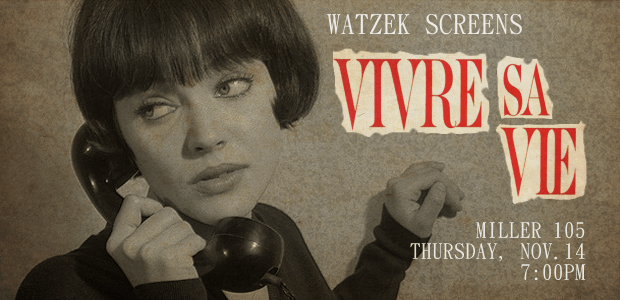
Jean Luc-Godard’s first flight was slow and iffy. Although a prolific writer for Cahiers Du Cinema, he was the last of the French New Wave directors to complete a film, and his initial work ethic does not instill one with great faith in his abilities: no script; a storyline that continued to mutate on a daily basis; no shooting permits; a cast and crew kept in the dark until the last minute. And yet somehow, Breathless, released in 1960, quickly became the pinnacle of urban Sixties Euro-chic and remains today arguably the most famous French film of all time. On its heels came two financial and critical disasters: A Woman Is A Woman, a comedy/musical Cinemascope extravaganza that left both public and critics confused, and Le Petit Soldat, a political film–Godard called it an “adventure” film–about France’s escalating colonial war in Algeria, which received the coveted honor of being denied both the “visa d’exploitation” and the “vida d’exportation” from the French government’s Minister of Information, meaning it was banned both at home and abroad. During this time, he met and married Anna Karina, who had leading roles in Woman and Soldat, with the pair also famously appearing in Agnes Varda’s Cleo From 5 to 7 as the two silent actors in the film within a film, something that surely appealed to the self-reflexive cineaste in Godard.

But the honeymoon period was short-lived. Godard was psychotically jealous and went so far as to ask Karina to stop acting once they were married, to which she responded by accepting a leading role in a film by Jacques Bourdon, Le Soleil dans l’oeil. On location in Corsica, and growing increasingly estranged from Godard, she fell in love with her co-actor Jacques Perrin and had an affair. Back in Paris, she told Godard about Perrin and that she wanted a divorce. The possessive Godard completely destroyed the furnishings of their apartment and left. Karina attempted suicide, taking an overdose of barbiturates that by all accounts would have killed her had Perrin not unexpectedly broken into the apartment after not hearing from her. While Karina was hospitalized, at a bistro Godard challenged Perrin to dice (a New Wave duel?) and then poker, which was interrupted by a public fistfight with photographers. Both then went to Karina’s bedside. It was through this lens of harmony, and a shaky reconciliation with Anna Karina, that Godard approached his next project, Vivre Sa Vie.

Image1
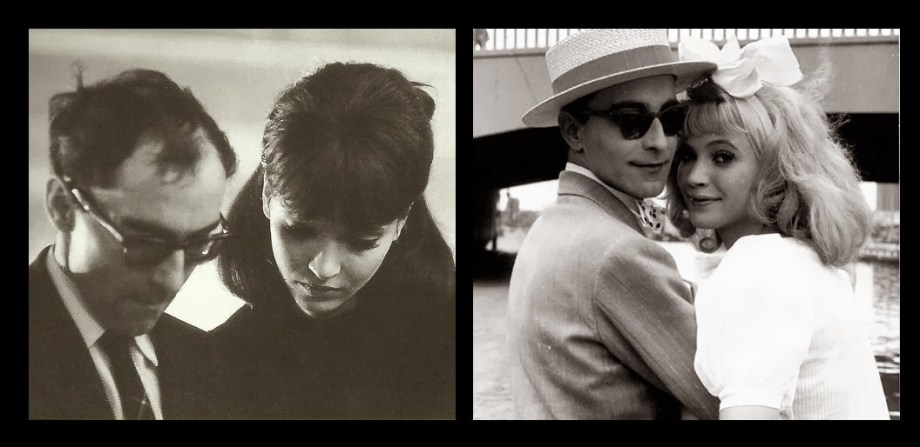
LEFT: Godard/Karina filming Alphaville / RIGHT: “Silent” cameo in Varda’s Cleo From 5 to 7

More so than with most directors, it is nearly impossible to separate Godard’s artistic output from his contentious and volatile private life. New Wave scholars have that demarcation line between his marriage to Karina and his growing radicalization in the wake of the 1965 escalation of the Vietnam War. But it is starting here, with Vivre Sa Vie, that both Godard and Karina broke new ground, or at least pushed heavily on its boundaries. Part of the reason that it is hard to differentiate the couple from the film is the personal nature of the work itself. The lead is Nana, an obvious anagram for Anna, and the somber script, based on twelve “tableaux vivants” (or “living paintings”) in the life of a sex worker, is in turns vengeful and empathetic. Whereas in the past Anna Karina was a lead, in Vivre Sa Vie, she becomes the film’s raison d’être, the focus of both Godard’s passion and his hatred.

Technically speaking, Godard had never worked this way before. Sets were static, mics limited, cameras heavy and immobile. Each scene was often comprised of several long takes meticulously set up by Godard and cinematographer Raoul Coutard, with few cuts or edits. It was the first film ever to abandon post-synchronized sound, the process where ambient sounds and dialogue are added or embellished in the studio following the shoot. Godard, completely committed to this idea of capturing snapshots of authenticity, wanted all sound recorded on a single track, on the set, which meant even more limits to actor movement and blocking. The song coming from the jukebox must sound like a song coming from a jukebox, and not act as a brief segue into a full-fledged studio recording: it was a strangely philosophical approach to sound that he stuck to religiously throughout the shoot. The camera, although moored, swings pendulously within scenes, often obscuring faces or shooting actors from behind as they speak to one another, as in the extended opening sequence where Nana speaks to her ex at the bar, our only glimpse of their facial expressions cast via the mirror behind the counter.

Despite the liberation inherent in the title, which roughly translates as “to live one’s life”, in the end, this is inescapably a film about Godard and Karina’s demise, a melancholic-if-beautiful exercise in which one often feels the uncomfortable role of psychoanalytic voyeur. Anna Karina puts in one of the best performances of her entire career (her tear-streaked face as she watches Dreyer’s The Passion of Joan of Arc remains one of the most famous film stills of all time), and Godard would rarely give such autonomy to a female protagonist again. Despite this being an attempt at drawing them closer, if anything, it seems to have done the exact opposite, as Karina would again attempt suicide before the production was finished and Godard could often be found sleeping on the floor of his producer’s office. Nevertheless, they managed to continue working together, collaborating on such classic projects as Alphaville, Band of Outsiders, and Pierrot Le Fou, before going their separate ways. Today Vivre Sa Vie remains the subtle, understated flashpoint of the brilliance that was to come.