Category: Music

Who In the World Was Benyamin S. (Benyamin, Bang Ben or Babe)?

By Karen Lee

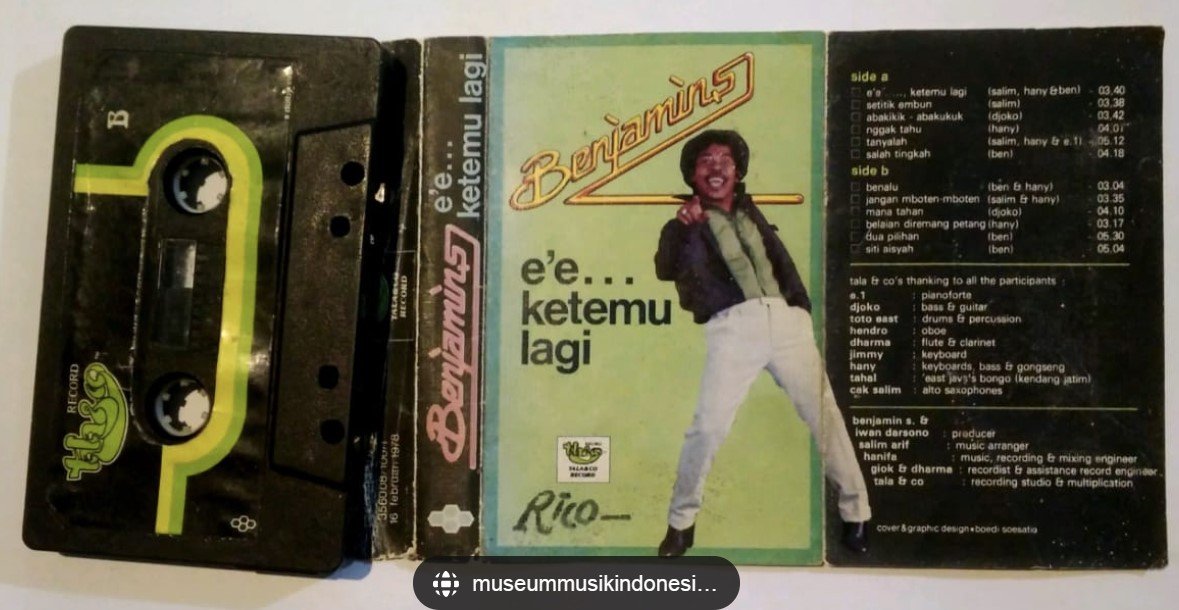
I discovered Benjamin S from receiving his album Kompor Meluduk for Christmas from my partner a couple of years ago. Upon hearing it, our minds were blown from the juxtaposition of soulful, funky eccentricity with psychedelic fuzz rock, plus some swinging duets with a woman vocalist, Ida Royani. Since there was zero information on the sleeve, I was inspired to ask, “Who in the world is Benjamin S?” 

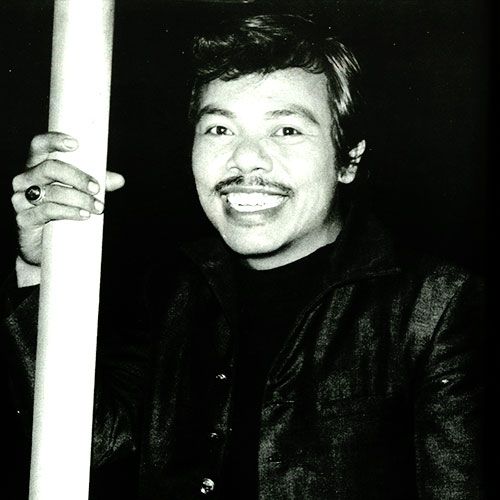
Benjamin Sueb, a.k.a. Benyamin S, Bang Ben, or Babe (March 5, 1939-Sept 5, 1995) was a prolific Indonesian comedian, singer/rapper, radio producer, director and actor who produced 61 films and 312 songs, which included 165 singles and 147 duets. He also produced 5 comedy albums, 2 soundtracks, and 10 compilations. Sueb was of Betawi descent. The Betawi are Islamic native peoples from Indonesia who are from mixed race marriages and blood lineages, including Chinese, Arab, Portuguese and Dutch colonies, from various tribes in Jakarta. Sueb was the youngest of eight siblings, born to parents Siti Aisyah and Sueb in the Utan Panjang Kemayoran village. Unfortunately due to poverty, the Sueb-Aisyah siblings lost their father when Benjamin was two years old, and he took it upon himself to be an entrepreneur at the age of three, busking in his village to pay school fees and buy/barter food to help feed his family. Entertaining may have come naturally to Sueb, being influenced by grandfathers Saiti, who played clarinet, and Haji, an Ung Dulmuluk player who performed at Indonesian folk theaters in Dutch colonial times (Wiki). 

Sueb was a charismatic, curious and inspired child who had many friends. His small appearance enabled him to attract audiences from an early age. He formed a “canned” orchestra with his brothers in third grade, where they would bang on cans using stems from kebabs and biscuit tins. Once in high school, he joined a school band named the Melody Boys. The Melody Boys played song styles which included dangdut (traditional pop derived from Arabic, Hindustani and Malay) and gambang kromong, a Betawi gamelan music played on a ukulele-type instrument, and also a type of off beat/pentatonic scale music played by orchestras in Indonesia, with two ukuleles, guitar, cello and bass. He also played Western music incorporating cha-cha, jazz, rock and blues imported by Indonesian musicians such as Bill Saraghi, Jack Lesmana (guitar player), and Rachmat Kartolo (singer/actor). Sueb performed with Saraghi and Lesmana at the Hotel des Indes, singing Western hits such as “Blue Moon,” “Unchained Melody,” and “When I Fall in Love.” In the 1960s, the Indonesian government issued a ban on Western propaganda and routinely interrogated artists who played Western songs and failed to conform to societal standards. To navigate the sociopolitical ban on Western influences in Indonesia, Sueb maintained he was contributing to keeping Betawi culture alive through his own compositions. Sueb’s songs often mirrored James Brown’s soul sound or John Mayall Bluesbreakers’ blues, with synthesized rock, funk, gambang kromong and dangdut sounds. 
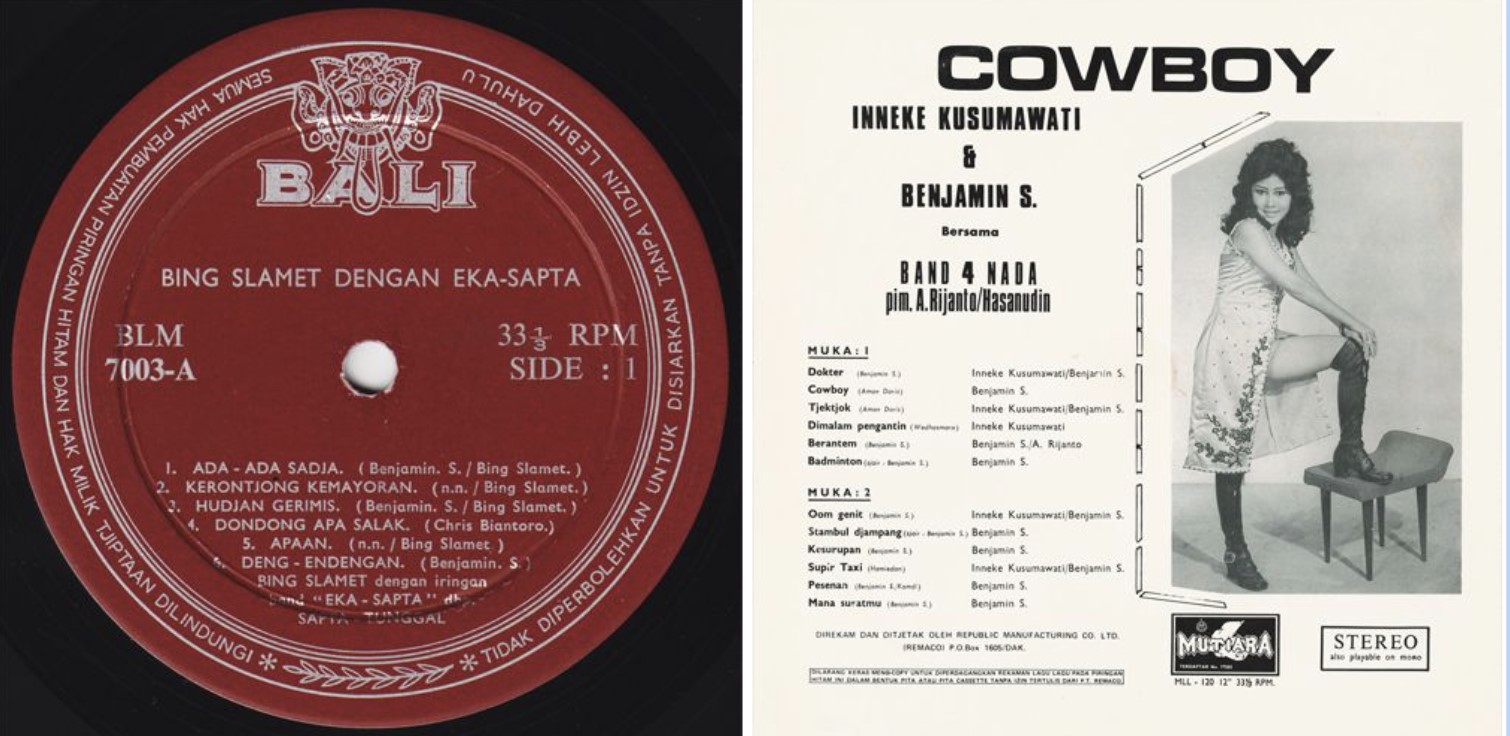
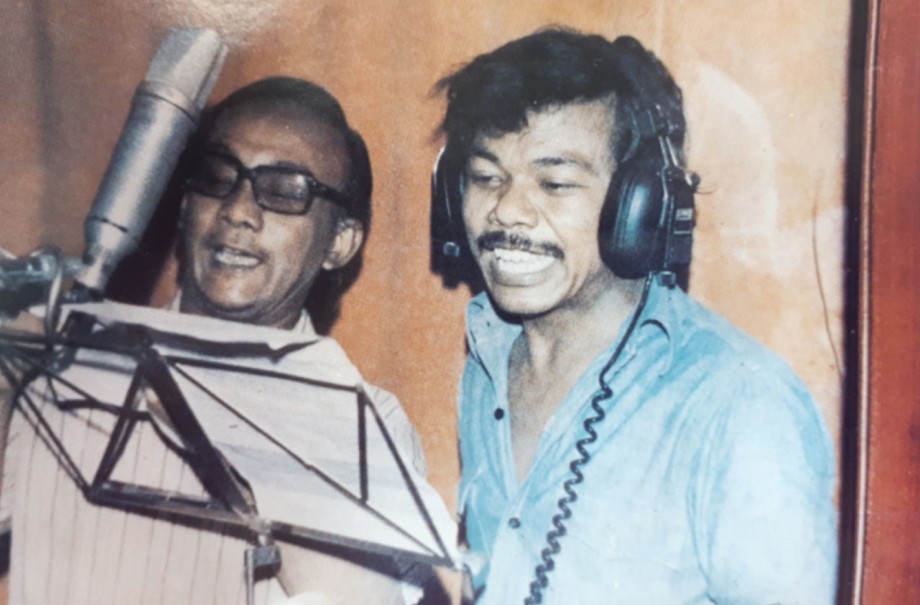
In 1968, Sueb composed the songs “Nonton Bioskop” (Watching a Movie at the Theater), “Hujan Gerimis” (Drizzle), “Endeng-Edndegan” and “Ada-Ada Saja” (It Is What It Is) for Indonesian singer/actor Bling Samet. All became big Indonesian hits. From 1968-1971, Sueb recorded and released no less than 50 albums, including the bestsellers Si Jampang (1969) and Ondel Ondel (1971). He also starred in 54 films, until 1976. He was honored by the Indonesian Film Festival, winning the Citra trophies for Best Main Actor in, Intan Berduri (1973) and Modern Doel Anak (1976). In 1977, he wrote a song for the Indonesian government named “Pungli,” which translates to “Extortion” in English, perhaps to help inspire positive citizenry and promote social order in Indonesia, which was suffering from corruption.

Sueb’s intersectionality growing up in poverty may have contributed to his prolific career. He often created his works from the standpoint of marginalized populations, his stories connecting and resonating with his fellow peoples due to “commoner” contexts. Sueb was propelled to superstar status in Indonesia by starring in films that focused on local archetypes: tukang (or “handymen”) in Tukang Solder and Tukang Becak; waria (or “transgender persons”); lovesick partners; bohemians; artisans; and eccentric horror movie characters. He formed a film company, Jiung Film, and produced works such as Musuh Bebuyutan (Arch-Nemesis; 1974), Benyamin Koboi Ngungsi (Benjamin the Refugee Cowboy; 1975) and Hippies Lokal (Local Hippies; 1976). He also starred in 11 films with his name in the title, like Benyamin Biang Kerok (1972), Benyamin Brengsek (Benyamin the Asshole; 1973) and Benyamin Jatuh Cinta (Benyamin Falls in Love; 1976) and others (Revolvy). 

In the 1980’s, Sueb starred in Betty Bencong Slebor (Betty the Frightful Transvestite), an important film that openly presents waria (transgender) and homosexual behavior in Indonesia. Unlike neighboring countries Singapore and Malaysia, which were influenced by British colonial rule, Indonesia did not criminalize homosexuality. Sueb’s character Betty challenged the moral ideals propagated by Suharto’s “New Order” beginning in 1966, to control the social order by limiting Westernism in Indonesia and promoting Muslim ideals based on gender ideology. Suharto’s rule, a.k.a. ibu-ism, promoted men as being “productive” beings and women as “reproductive” beings. Suharto promoted concepts of gender conformity. In order to be a “whole” person, Indonesians must conform to gender roles according to heteronormative family principles. Men are the head of the household, with woman as wife and raiser of children, all aligned in harmony with Islam. The government pushed heteronormative conformity through public campaigns that reinforced the expectations for women to reproduce and be obedient mothers/wives because this was their God given “destiny” (kodrat). Morally, homosexuality was seen as contradictory to God’s nature for Muslims in Indonesia, even though Indonesian indigenous language and culture acknowledged transgendered and homosexual behavior and allowed it to play a part in religious rituals (Munir, 2014).    

Photo courtesy of Kineforum

Betty Bencong Slebor stars Sueb playing a waria servant who serves the wealthy Bokir family, owners of a recording studio. In modern Indonesia, a waria is an indirect term derived from abbreviating wanita (woman) and pria (man), or “men with women souls.” LGBTQI+ Western binaries do not translate to Indonesian traditional societies, where ethnolocalized identities parallels links between professions with homosexual and trangendered behavior, e.g. gemblak-warok partnerships participating in the reog drama rituals in East Java, and male-to-female priests, or bissu, conducting religious rituals and rites in South Sulawesi neighborhoods. Betty is a jobless young man who becomes waria for employment much like ethnolocalized reog drama rituals of bissu, rather than becoming waria to conform to sexual/gender identity. Betty Bencong Slebor also challenges how social concepts in stereotyped gender binaries shape feminine and masculine traits that are attached to sexual identity. Betty dresses with make-up and wears her hair in a bun to appear attractive or “feminine.” She is a subservient maid who takes care of the family she serves. Betty also exudes toxic masculine traits by mocking a weak male pedicab driver because he cannot transport her up a hill in his pedicab. She sees him as weak and takes her aggression out on him by ridiculing him and throwing him into a field. Afterwards she squats in the field to pee, imitating women’s urinating behavior. Betty Bencong Slebor intelligently contrasts the fluidity of maleness and femaleness coexisting, although the concepts are not always fixed and mutually exclusive (Munir, 2014). Unfortunately Sueb closed his film company after he made Betty Bencong Slebor due to financial difficulties.

Before Sueb’s untimely death, he founded his radio station Ben’s Radio, on March 5, 1990. Ben’s Radio’s purpose is to spread awareness for Betawi culture by transmitting Betawi culture through dialogue and musical programming. The radio station, located at 106.2 MHz FM in Jakarta and streaming online, is currently operated by Sueb’s children. The Sun City Girls wrote a song called “Ben’s Radio,” released on their album Funeral Mariachi on Abduction in 2010. The song opens with samples in Betawi taken from Ben’s Radio transmissions. Sun City Girls’ fans know members Charles Gocher and Richard and Alan Bishop often synthesized ethnic musics from South Asia, Africa, the Middle East and South America with jazz, rock, prog and experimental music. It makes me happy to think Sueb’s music has influenced legendary cult bands like Sun City Girls.
On Sept 5, 1995, Benjamin Sueb passed away from a heart attack after playing soccer. He was 56 years old. He is survived by his nine children and his wife, all of whom continue his legacy in keeping the rich Betawi culture alive. Indonesia continues to celebrate Sueb through Ben’s Radio as well as an autobiographical musical, Babe, performed by the Jakartan theater troupe Teater Abnon, in 2017. There is also continuing speculation among Sueb’s children and the Indonesian government about converting their father’s residence into a museum commemorating Betawi culture and Sueb’s unique life, a life cut short too soon. 

Photo courtesy of merahputih

(Originally published on Freeform Portland’s Blog.)

References

Munir, Maimunah (2014), Challenging New Order’s Gender Ideology in Benyamin Sueb’s 

Betty Becong Slebor: A Queer Reading http://www.plarideljournal.org/article/challenging-new-orders-gender-ideology-in-benyamin-suebs-betty-bencong-slebor-a-queer-reading/

Revolvy/BenyaminSueb

Wikipdedia Benyamin Sueb 

https://ipfs.io/ipfs/QmXoypizjW3WknFiJnKLwHCnL72vedxjQkDDP1mXWo6uco/wiki/Benyamin_Sueb.html

Written by Karen Lee (Weekend Family Music Hour)

Nigerian Afrobeat: The Wings, Original Wings & Super Wings

FullSizeR(4)

(We are deeply indebted to original band member Manford Best Okaro for everything below. See his incredible book History of the Wings for additional information.)

In 1966, civil war erupted in Nigeria. Hostilities had been building since the bloody Kano riot of 1953, and the discovery of additional oil reserves in the east reignited the conflict. The Prime Minister and his cabinet were killed in a coup by Igbo secessionists who declared themselves the breakaway Republic of Biafra. “The perpetrators brazenly looted properties, raped women and committed unfathomable atrocities under the guise of a religious uprising,” Wings guitarist Manford Best recounts in his book, History of the Wings. “This exodus led to an influx of refugees and caused untold hardship such that hunger and starvation became the orders of the day.” Young men in Biafra were expected to fight for the survival of the new republic, but the safer gig was logistical support for the military. This included bands to perform at bases and official events, and to boost overall troop morale. Hence, the Biafran Air Force created a band called BAF Wings.

3b
Biafran Air Force, 1967.

BAF Wings consisted of two distinct units of musicians: a popular highlife section, led by established bandleader Adolf King; and a second smaller line-up geared towards the “beat” pop music of the day. This pop band consisted of Dream Lovell (Dan Ian) on lead guitar, Gab Zani on lead vocals, Jonathan “Spud Nathan” Udensi on rhythm guitar, Arinze “Ari” Okpala on bass, and Manford Best on drums, with Frank Moses Nwandu acting as manager. The military paid for instruments, amplifiers, and a bus for transportation between assignments. The two sections continued on until the collapse, as recounted by Manford Best:

“After Christmas 1969, it became clear that Biafra was about to lose the battle. When non-stop gunfire and mortar shells started landing everywhere indiscriminately, we knew that advancing Federal soldiers had finally broken through in several sectors. As people in general including the highlife section ran for their dear lives in different directions on foot, members of the pop music section decided to converge at Azia, which was Spud Nathan’s village. Despite the fact that there was no time for a thorough movement plan, we were able to salvage two amplifiers, three microphones, loud speakers, the drumset and two guitars as we fled. Thereafter, we went to our various villages to reunite with members of our families and for them to be aware that we survived the war.”

A ceasefire came in 1970. The country was devastated, especially the east, with civilian deaths a staggering 500,000 to 3,000,000, mainly from famine and disease caused by the blockade. Nigeria was temporarily divided into four states, and the renowned sounds created by the funk bands of the defeated Biafran independence movement quickly began to take hold and spread across the nation. The reformed band, now simply The Wings, decided to base themselves in Enugu, the new capital of eastern Nigeria, focusing on hotels as their mainstay. If you could get steady work at a hotel, you could become a sort of house band there, building a following and making enough to live on. Any spare income earned by the band was invested back into improved equipment (synthesizers and organs were notoriously hard to maintain), and through this process, they became regulars at the Dayspring Hotel on Sunday afternoons, playing primarily pop/soul numbers by The Beatles, James Brown, Sly and the Family Stone, and Otis Redding.

A significant setback occurred when lead guitarist Dan Ian (later of Wrinkar Experience) and singer Gab Zani (later of One World) decided to leave the band, which effectively ended their tenure at the hotel. Just as the band was on the verge of splitting, their manager was approached with a fortuitous offer of a 1-year contract with 33rd Brigade Headquarters in Maiduguri. This meant a monthly salary, free housing, health care, all new musical gear, plus a new bus. The members of the band agreed that it was a great opportunity, despite the lack of autonomy that went along with being a military attachment; at least there was no war. They quickly grabbed two new members to flesh out the lineup: Okechukwu “Okey” Uwakwe, a lanky guitarist from a band called The Wavelengths; and Pius Dellin, a keyboard player from neighboring Kano. The band’s existing rhythm guitarist Spud Nathan, who had already been singing some highlife numbers during the band’s hotel sets, mainly to give vocalist Gab Zani a break, stepped in to lead vocals and began honing his voice.

It was now 1971 and pop music was making inroads on the African highlife scene. Fela Kuti and his drummer Tony Allen, inspired in part by Sierra Leone’s funk stars Geraldo Pino & the Heartbeats, are credited with coining the term “Afrobeat” to describe this new sound. EMI’s Nigerian subsidiary began scouting local talent to sign, as did Decca. When not performing for military functions, The Wings were free to gig around the city of Aba at will, and they quickly became a fixture in the burgeoning club scene, primarily at the Ambassador and Unicoco hotels, where they played with house band The Funkees. This led to their being signed by EMI.

Youll-Want-Me-Back
“You’ll Want Me Back” 7″, 1972

In early 1972, the band headed to Lagos and recorded their first 7” single, entitled “You’ll Want Me Back” b/w “Catch That Love.” The release sold well and brought them nationwide radio exposure for the first time. This was followed within six months by “Afam Efuna” b/w “Had I Known” on the HMV label. At this point, due to increasing opportunities and regional fame, they opted not to renew their contract with the military, which resulted in a punitive confiscation of all gear and equipment which the military had purchased, including their bus. Once more, the band was destitute and on the verge of financial ruin.

Jake Sollo and The Funkees, looking to relocate to England, arranged for the sale of their instruments to The Wings through negotiations with EMI, the label of both bands. This enabled the recording of their third and most successful single to date, in October 1973: “Someone Else Will” b/w “I’ve Been Loving You.” Former member Dan Ian played guest rhythm guitar on the track while his two sisters, Callista and Meg Mbaezue, sang backing harmony over Spud’s vocal. The band’s popularity accelerated quickly, culminating in their appearance on the premier musical program on NTA, the Nigerian Television Authority.

69770
Kissing You So Hard, The Wings, EMI/Capitol, 1974

For reasons unclear but purportedly to strengthen the rhythm section, additional percussionists Emma Dabro and Dandy Aduba were hired. Manford Best moved from drums to rhythm guitar, replaced by veteran highlife drummer Joel Madubuike, who is credited only as “Noel” on the back jacket of their first LP. It was with this lineup that The Wings entered EMI Studios in Lagos in April 1974 to record their first and only full-length album, Kissing You So Hard, with Pal Akalonu producing. The album was a regional success and stands today as one of the finest Nigerian pop records of all time, starting with Spud Nathan’s anthem “Single Boy” and ending with Uwakwe’s prophetic and plodding groove “Gone With The Sun.” (Due to a manufacturing issue, several songs are reversed in the running order for all copies I’ve seen.)

The production sound is cavernously wonderful and strange, with bursts of guitar and organ moving up high in the mix, disappearing, then surging back, all held together by Ari Okpala’s flying bass lines; check out “Make Me Happy,” with its two distinct passages of Uwakwe’s fuzzed-out guitar and Dellin’s organ breaks, punctuated with Madubuike’s precision drum fills. On the technical aspects of the recording process, Manford Best states that “while all the instruments were being played with the singing going on, the engineer skillfully recorded all the inputs at a go.” The album’s philosophical centerpiece is Spud Nathan’s cut “But Why,” in which he bleakly describes his “struggle to exist” when “emptiness drowns his whole life.” The song’s brooding spirituality would obsess fans for years, especially in light of what was shortly to come.

FullSizeR(3)
(L-R: Dandy Aduba, Spud Nathan, Pius Dellin, Okey Uwakwe, Manford Best; photo, M.Best)

December 26, 1974. The band played a gig at Mbaukwu. Stories differ as to what went down from this point forward with regard to a disagreement that night within the band. According to Best’s recent account, it was an established practice to rotate a leader monthly between the band’s core four members (Spud, Manford, Ari, and Okey). Spud was supposed to hand over leadership to Manford on December 24th, but he refused to do so for reasons unclear; the latter theorizes it was because a lucrative show was coming up in Port-Harcourt, and Spud wanted to be the one to collect and distribute the money. Tempers flared but Spud ultimately agreed to hand over control to Manford and rode with him in his newly-purchased Toyota to the next gig as a conciliatory gesture. At 4:00am, the band departed in separate vehicles to the town of their next show. Spud and Okey rode in Manford’s car and slept. What happened, according to Manford, is as follows:

“At about 6:00am, two kilometers after crossing the notorious Njaba bridge, we reached Azara-Obiato village and I was turning a corner when suddenly I saw a woman crossing the road. I tried to avoid her by swerving to the left but on seeing an oncoming vehicle swerved back to the right, lost control of the car and knocked her down in the process. The car skidded over the embankment and somersaulted in the bush resting finally on its side. The noisy impact of the crashing car and the alarming cries of the injured woman attracted villagers to the scene. They turned over the car to its normal position, forced the door open and carried Okey and I out while others rescued the woman. When I regained consciousness I stood up and heard Okey moaning and saying some indistinguishable words. I tried to help him stand up but he could not. This was because of the excruciating pain resulting from his injuries. I looked around and could not find Spud so I started shouting.”

FullSizeR(5)
Manford Best’s Toyota

Spud Nathan had been thrown from the car’s window; his neck snapped. Okey, writhing in pain and unable to stand, was placed on a bus and transported to two different hospitals, since the first lacked the expertise to handle the traumatic damage done to his spinal cord. The rest of the band, traveling in a different vehicle, would not learn of the crash until the following day. Word traveled fast throughout the region about the wreck and the circumstances behind it, feeding rumors and conjecture among fans and friends. Internally, between the bad blood from the fight beforehand, Best’s comparatively superficial injuries, and the mysterious unidentified “woman on the bridge,” suspicions arose immediately. Existing rifts between Best and the other founding members, especially Ari Okpala, erupted. According to Best, an assassination attempt was made on his life shortly after the crash, which he attributes to either Okpala or Spud Nathan’s sister in London. Ari Okpala and the other members decided to dissolve the band for two years in honor of their dead friend.

True to their plan, in 1976, Ari Okpala founded a new outfit called Original Wings International. Of the Kissing You So Hard lineup, only Okpala on bass and the hired percussionists, Dandy Aduba and Emma Dabro, remained. Johnny Fleming, who had briefly toured with an earlier pre-1974 iteration of the band, returned to replace Pius Dellin on keyboards. With Okey Uwakwe now paralyzed, Charles Effi Duke took over on lead guitar while Jerry Demua was hired to replace Spud Nathan on lead vocals. Drummer Joel Madubuike, who had already split to join the popular funk band The Apostles, was replaced by Emma Chinaka, a.k.a. Emma China.

R-3627395-1337952286-1179.jpeg-1
Men of the People, Super Wings, Clover Sound, 1976

Meanwhile, keyboardist Pius Dellin (also excluded from the Original Wings relaunch) alerted Manford Best of the brewing betrayal by their old comrades. Furious and feeling slighted, he immediately formed a rival band called Super Wings, with Pius on keys and four other musicians: John-John Duke on bass; Johnson Hart on drums; and George Black and Jerry Boifraind on vocals/percussion. Afraid of getting beaten to the punch and wanting to stake their claim to the name, they rushed into the studio to record a new album, signing to Lagos-based label Clover Sound, run by Ben Okonkwo. The resulting LP called Men of the People was, by Manford Best’s own account, a bit of a mess in the mix department, despite some ace performances, particularly the tracks “Lonely World,” “Trust Your Woman,” and Dellin’s shimmering “Sunshine of Tomorrow.”

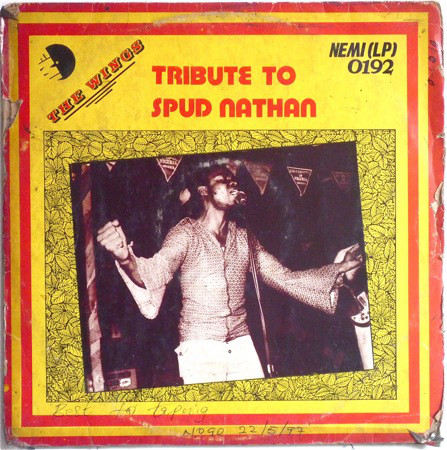
tribute
Tribute to Spud Nathan, Original Wings, EMI, 1976

Although Men of the People is revered today as a classic, back then, this mad dash to the marketplace backfired. Sales of the LP were flat, and their second-rate status was soon sealed, when, just weeks later in 1976, Ari Okpala’s Original Wings released their own album, entitled Tribute To Spud Nathan, on Nigeria EMI, its cover sporting a photo of Spud, arms outstretched and in belled sleeves, singing onstage at a University of Nigeria show. Starting off with the tribute song “Spud Nathan,” which acknowledged the acrimonious splintering and promised peace from this point forward, it is a meticulously crafted record from start to finish, every bit as good as its forerunner Kissing You So Hard. Inspired rhythmic standouts include “Tell Me,” “Don’t Call Me A Fool,” and “Love Is Meant For Two.” It was, by all accounts of the time, a major comeback in the Nigerian pop scene.

R-5054206-1476475053-8052.jpeg
My Love Is For You, Super Wings, Clover Sound, 1977

Super Wings would persevere for one more record, again on Clover and with Ben Okonkwo producing. Most of the lineup remained, sans Jerry Boifraind, who left to record his first two solo LPs for Anodisc and Love Day. Lessons were clearly learned from the rushed release of Men of the People, and 1977’s My Love Is For You is the band’s creative apex. Manford Best’s crisp, reverb-drenched riffs, mixed with Pius Dellin’s organ and new vocalist Allwell Opara’s radical warbly vibrato, make for a distinctive and powerful unifying sound throughout its nine tracks, including “My Own People,” “Papa Was So Good,” and “Something (Love)’s Missing.” In true competitive form, that same year also saw the release of the Original Wings LP You’ll Want Me Back, which featured a re-worked version of the first 7” release by The Wings. While a fantastic record (“Stoop To Conquer,” “Help Yourself” and “Anonymous Man” are high-energy standouts), the balance between Original Wings and Super Wings was now shifting a bit.

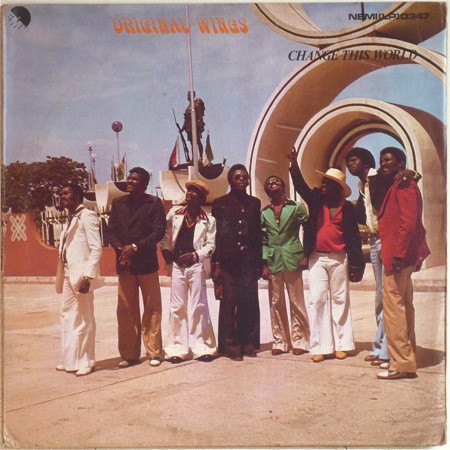
change
Change This World, Original Wings, EMI, 1979

But it didn’t matter. The market was changing. Nigerian Disco and the spinoff scene later codified as Boogie were on the ascent. Funk bands across the country began closing up shop, with some musicians shifting increasingly into arrangement and production work. Manford Best shut down Super Wings and recorded two renowned solo albums. Original Wings released the superb Change This World in 1979 before Ari Okpala decided to dissolve this iteration of the band permanently. Johnny Fleming would use the name Original Wings In London for his excellent solo album Forgive Me from 1981, and some members (or at least Dandy Aduba on rhythm guitar) would return as backing band Wings International on Okpala’s synth jammer record Better Love, released on EMI Nigeria in 1985. It is the last release of his that I know of.

Founding lead guitarist Okey Uwakwe’s eventual death in 1977, from spinal injuries sustained in the car crash years earlier, was the sad closing coda for both outfits. Today, “The Wings of Aba” and the name of Spud Nathan are legendary in Nigeria.

The Wonderful World of Electronic Voice Phenomena

Electronic Voice Phenomena (EVP) are sounds or voices that are transmitted through electronic sources. They can be recorded and heard during or after playback from recordings on analog or digital machines. People who believe in the paranormal often postulate EVP are voices from deceased people, demons, aliens or beings from an unknown dimension who are trying to communicate with the living. These sounds or voices are often interpreted as radio or other media transmitted interference that have been recorded at lower frequencies, where hearing these sounds/voices in real time is often inaudible during the recording. EVP recordings often appeal to fans of experimental, electronic, or noise music genres, sometimes combining instrumental melodies and layers of white noise. EVP frequencies may also be strengthened by short wave radio or digital signals, where para-psychics are able to “tune in” to capturing and conversing with these phenomena.     

The first spirit voice was recorded on tape by Reverend Drayton Thomas while working with Gladys Osborne, a famous medium who channeled Thomas’ deceased father during a seance in the 1940s. Psychologist Raymond Bayless and psychic Attila von Szalay researched the recording of EVP from hearing voices around them. Attempts were made to record these voices with a 78 RPM Pack Bell Record Player and Cutter but to no avail. Bayless and Sazalay eventually constructed an EVP recorder consisting of a microphone inside of a cabinet resting inside a speaking trumpet. A cord connected to the microphone led to a tape recorder outside of the cabinet, which was connected to a loudspeaker. They heard whispers from inside the cabinet upon connection and recorded the occurrence. Szalay continued to capture EVP recordings on reel to reel tape, and Bayless and Szalay published an EVP article in 1956, in the Journal of the American Society for Psychical Research (Poysden, 1999). 

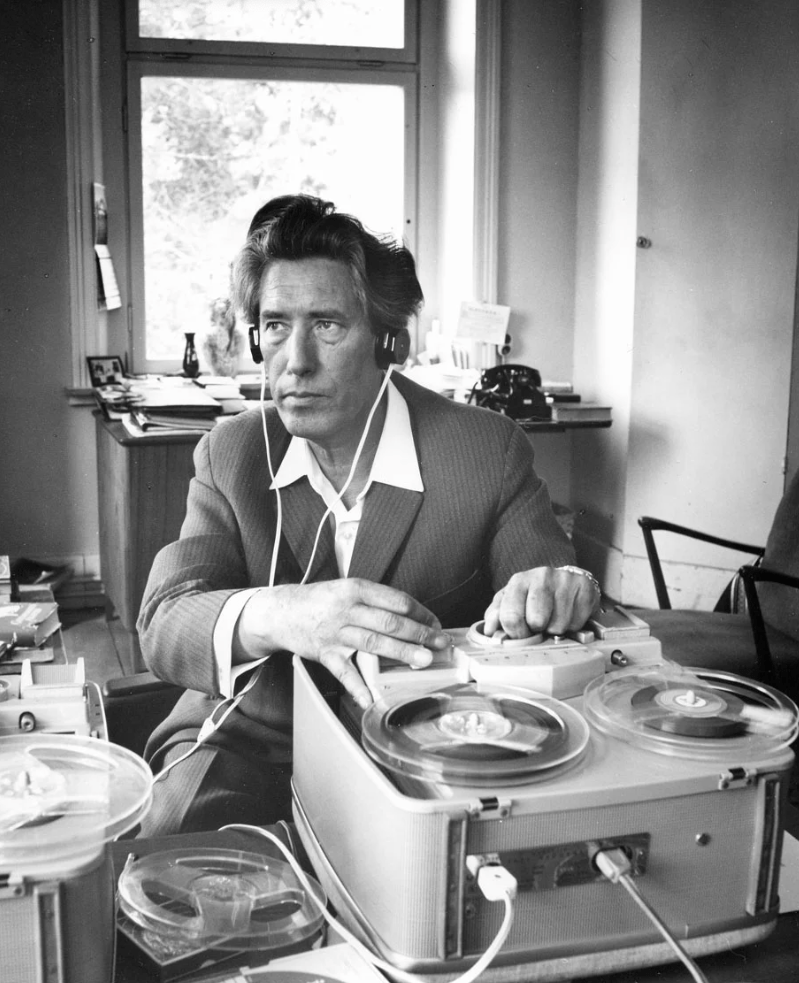
A notable EVP early researcher was a retired Swedish opera singer, bird watcher and film producer by the name of Friedrich Jurgenson. After recording bird calls in a field near his home, when he played the recording back, he noticed voices on the tape. He believed one of the voices was his dead mother calling his name, while other voices spoke in different languages, sometimes changing vernacular in the middle of a sentence. There were often grammatical errors or words uttered with elongated syllables, and some voices even seemed to respond to his questions while he was listening and talking back to the tape. He began transcribing his conversations and, after four years of research, authored a book published in 1963 in Stockholm, Roesterna Fraen Rymden (Voices From the Universe). Jurgenson hypothesized the tape recorder was acting as a CB (citizens’ band) radio in communicating with the dead (Poysden, 1999).

Friedrich Jurgenson

Jurgenson influenced Latvian psychologist Dr. Konstantin Raudive after he read Jurgenson’s book in 1964. He was so intrigued by Roesterna Fraen Rymden (Voices From the Universe) that he contacted him in 1965 to further research EVP. After numerous recordings, upon playback they detected faint voices in Latvian, French and German, one of the voices belonging to a French woman known to Raudive, Margarete Petrautzki, who had recently passed away from illness. Raudive transcribed the recorded voice, saying “Va dormir Margarete” (“Go to sleep Margarete”). Raudive spent a large part of his life studying and researching EVP. He came up with several techniques in channeling, recording, and contacting spirits using various electronic devices. He recorded over 70,000 audiotapes in his laboratory and collaborated with Hans Bender, a German parapsychologist, as well as 400 others who had heard the voices Raudive had recorded and communicated with in his 1971 book, Breakthrough. Raudive listed three methods in capturing EVP, including: 

Konstantin Raudive – Breakthrough (Full Recording)

  1. Microphone voices; pressing the record button on a tape recorder with a microphone in an empty room or place; the tape recorder sometimes does not have to be turned on. 
  2. Radio voices; recording white noise from the radio without being tuned to a station. 
  3. Diode voices; recording homemade simple radio receivers powered by two terminal electronic components not tuned to a station.  
Konstantine Raudive (Pic: TCI Argentina)

Raudive describes the characteristics of voices one may hear, including entities speaking in rapid mixtures of languages or in different rhythms that appear to be forced, some similar to short telegram messages or neologisms (Antiworld.se, 2008). He claims voices on the diode method were audibly stronger when more white noise was present. Many critics presumed EVP were samples of normal radio transmissions coming in from differing radio frequencies but critics could not explain why the voices were able to mutter Raudive’s name recurrently. Many spirit voices also had a sense of humor, appearing to become bored, tease, or converse about the weather. On the Vista label, Raudive released a 7” record with his expanded version of Breakthrough: an Amazing Experiment in Electronic Communication with the Dead, published in England by Colin Smythe Ltd. in 1971. It included spirit messages from Ortega Y Gasset and Russian poet Vladimir Mayakovsky. 

In the U.S., Thomas Edison was a believer of EVP, and he discussed how to record spirit voices in 1928, later attempting to utilize modified television sets, tuning them to 740 megahertz to enable paranormal effects (Poysden, 1999). In Europe, EVP became popular in the 1960s and 1970s, where many amatuer para psychics dabbled with homemade tape recorders. In the late 1970s, Americans Paul Jones, G.W Meek and Hans Heckman started a lab researching two way voice communication using more advanced equipment. George and Jeannette Meek met psychic William O’Neil, who was “electronically literate” and could hear and see ghosts. The Meeks funded and directed research into spirit communication while O’Neil operated electronic methodologies and used his psychic expertise. O’Neil was able to communicate with a deceased colleague, Dr. Jefferies Mueller, who was a professor and NASA scientist who materialized in O’Neil’s living room to announce he was going to help construct new electromagnetic equipment to convert spirit voices into audible voices. The device was named Spiricom, with a set of tone and frequency generators that relayed 13 male tones extending all ranges of the adult male voice (Afterlife, 2014).

The Meeks founded a non profit organization, Metascience Foundation, in the 1970s to interpret dimensions that separate the living and the deceased and the many levels of planes between, which they described as interpenetrating or interwoven worlds or spaces. The Metascience Foundation objectives were to  provide a scientific basis for knowing:

  • That life is eternal
  • That each person is a son or daughter of God, the Father, the Universal Mind or the Creator of all that exists
  • That the life of each person is of infinite importance and has specific purpose and ultimate meaning
  • That limitless love of neighbor and self leads to inner peace, happiness and good health

The Meeks believed these levels of understanding can be achieved through direct contact with “accumulated wisdom of the ages, currently available on the Mental and Causal Planes. It is our conviction that the most reliable access to this information can be perfecting a dependable two-way electromagnetic-etheric communication system” (itcvoices.org, 2016). 

George and Jeanette Meek

The Astral Planes According to George Meek

George Meek believed that mystic and spiritual worlds throughout the centuries had failed to explain the vastness of the universe, or parallel universes that have interpenetrated our physical universe. Meek found it odd that Spiritual folk always explained that the path to a higher god/deity lies within. He used electromagnetic fields and technologies to better understand the living plane from people who no longer needed their living bodies through EVP. “All the spiritual universes–and there are hundreds of them–they’re all sharing this physical space with our physical universe, like radio signals sharing this room” (Meek, 1991). To Meek, all universes are “broadcast” from a central source, naming deities like God, Allah, Buddha or Brahman. These universes are set up by deities and energy from deceased people, which are  finer energies than electricity, radio or light. These spirit energies cannot be accessed by living physical senses or modern scientific approaches, which is why he co-created the Spiricom with O’Neil (worlditc.org).

Among those attracted to these new theories of EVP was early electronic music pioneer and gay icon Joe Meek (no relation to George or Jeanette Meek), whose sonically strange recordings, the most famous being The Tornados’ “Telstar,” revolutionized experimental outsider pop in the 1960s. Meek mic’d toilets, played with pitch, and generally approached his work in the kitchen-sink fashion of BBC’s Radiophonic Workshop (one can only dream of a collaboration between Delia Derbyshire and Joe Meek). A firm believer in all things paranormal and occult, Meek conducted EVP recordings in his London studio because it was located on a busy street with lots of white noise. He also started recording in cemeteries, convinced that he was communicating with his idol, the late Buddy Holly. Meek’s 1961 song, “Tribute to Buddy Holly,” performed by Mike Berry and the Outlaws, may have been co-written with “Buddy” in Meek’s London studio. Like many of his productions, the structure of the song is strange, going on for an entire extra verse and additional minute after the bridge break and 2:00 mark, when most 45s would be fading out. This length gives it a trace-like quality. In the ultimate coincidence, Meek’s final psychic break, in which he notoriously murdered his landlady during a noise complaint before committing suicide, happened to occur on the day of Buddy Holly’s death, February 3rd. 

Joe Meek, in his U.K. studio

The most infamous EVP recording, The Ghost Orchid: A Introduction to EVP, was released by PARC (Parapsychic Acoustic Research Cooperative) and Ash International, in 1999. Filed under “Electronic,” this was the first ever comprehensive investigation into EVP ever to be released. Listeners are guided through a collection of music, voices and sounds that were recorded on tape, with a 12-page booklet accompanied by articles with criticisms, explanations and hypotheses surrounding the phenomena. The CD has commentary from Swedish artist Leif Elggren, England’s leading EVP researcher Raymond Cass, and one of the field’s early pioneers, Dr. Konstantin Raudive. This recording solicits listeners into questioning EVP evidence to help us examine our own perceptions or preconceptions about human existence and spiritual belief systems. Perhaps EVP are the answers we seek to validate our own existential crises. Or perhaps we hear what we need or want to hear, constructing a “meaningful” white noise world from nothingness.

Written by Karen Lee, edits by Jim Bunnelle

References:

Antiworld.se http://www.antiworld.se/project/background/evp.html

Electronic Voice Phenomena UK http://www.electronicvoicephenomena.co.uk/joe-meek-evp

Institute for Afterlife Research http://www.mikepettigrew.com/afterlife/html/evp___itc_history.html

Meek’s Interpenetrating Worlds of Life and Consciousness http://itcvoices.org/meeks-interpenetrating-worlds-life-consciousness/

Poysden, Mark : This is EVP: A Look Behind “The Ghost Orchid” CD https://www.anomalist.com/features/evp.html

World ITC.org http://www.worlditc.org/h_07_meek_by_macy.htm