Author: Center For Cassette Studies

Japanese Kayōkyoku Women Vocalists 1960s-70s

dd8bb6f2f8406dac4c175757966da1af

In Tokyo Boogie-Woogie: Japan’s Pop Era and Its Discontents, Hiromu Nagahara talks about western influences in Japanese pop music emerging 100 years ago. Jazz journeyed back over the Pacific on steamers by citizens traveling abroad, first in sheet music form, and then as 78s. It was a woman singer named Sumako Matsui who got it all going, in 1914, with a shellac side called “Katyûsya No Uta” which sold an unheard-of 20,000 copies. It was the beginning of a genre called ryûkôka (‘fashionable songs’). The trend continued into the 1920s as the recording industry matured and began cross-marketing music and cinema, with Chiyako Sato’s title track from the film “Tokyo March” so successful, it caused one critic to worry that “the taste of the citizens of Tokyo will become depraved beyond salvation.” As in the West, patriarchal fears of feminine empowerment were palpable as modernity and capitalism upended traditional gender roles. Japan’s militarist expansion from 1936-45 resulted in the banning of western music, but America’s postwar occupation brought Kasagi Sizuko’s runaway hit “Tôkyô Boogie-Woogie” whose lyrics incorporated words like ukiuki (‘buoyant’) and zukizuki (‘throbbing’) to rhyme with boogie-woogie.

Television and radio were key to the dissemination of imported rockabilly and surf music. The Ventures visit in 1962 is often referenced as a key moment in Japan on par with The Beatles landing at JFK in America. Japanese kids went wild for this new sound, dubbed ereki bûmu (‘elec boom’). Post-British Invasion, it became gurûpu saunzu (‘group sounds’), with vocal harmony and beats taking center stage. Although women were largely absent from these bands, they continued to be driving forces in enka and kayōkyoku, the two genres that had diverged from ryûkôka. Enka was ballad-centric, traditionalist, and has been compared to the Blues due to its melancholic tone. Kayōkyoku (‘pop songs’) borrowed heavily from western melody. Just as in the West, masculine attitudes surrounding rock music continued to dominate the discourse and define the parameters of what was worthy or authentic. As much as it was used to describe, Kayōkyoku was used to deride those who sang commercialized material written by others.

The Girl Group explosion that peaked in 1963 in the U.S. never really caught on in Japan. There were a few duet teams–The Peanuts, Jun & Nene–but most women artists were solo acts until the early J-pop era. Oddly, very few covered any of the U.S. Girl Group hits so common in other Asian states, like Indonesia, Malaysia, and Singapore; Japanese teen women singers were more likely to cover white adult-pop-market acts like Connie Francis than black teenagers like The Chiffons. Almost all of the top artists worked with original material, written for them by songwriting teams, much like a Brill-Building arrangement. Western covers were often album filler, with few appearing as 7″ releases. One exception to this is Italian singer Mina, who was hugely influential among artists like The Peanuts, Kayoko Moriyama, Maria Anzai, and Mieko Hirota, all of whom recorded and released Japanese-language versions of her songs as singles.

Biographical information in English is limited. Japanese name order has been flipped to reflect Western conventions. Anyone wanting to know more on the above period should check out Hiromu Nagahara’s book.   —   Jim Bunnelle

(Soundcloud yanked most of my uploads mentioned below, sorry. Most are on YT ripped by others.)


1269209

Hibari Misora

Without question, Misora is the most famous woman singer in the history of postwar Japanese pop music. Due to the fact that she was a child star, had yakuza mob connections, and embraced kitschy stage attire, writer Hiromu Nagahara called her the Japanese equivalent of Judy Garland, Frank Sinatra, and Elvis Presley. Her first recordings mimicked rival Shizuko Kasagi’s colonialist boogie music, but the 1950 release of “Echigo Shishi No Uta” introduced a new synthesis of East and West that silenced her early critics and put her on the path to superstardom. She recorded thousands of songs in a variety of genres, mainly in the enka style. Her biggest kayōkyoku hit came out on Columbia in 1967, an A-side called “Makkana Taiyō” (Deep Red Sun), where she is backed by Jacky Yoshikawa & His Blue Comets, one of the best Group Sounds bands.


yuz

Jun Mayuzumi

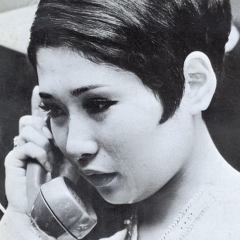
That’s Mayuzumi in tears as our profile pic, getting the news over the telephone that she had just won a prestigious music award in 1968. She was massively famous and had a great vocal range and dynamic stage presence, spending the majority of her career recording for Capitol Japan. Her debut 7″ release “Hallelujah” from 1967 started a long string of great songs: “Otome No Inori”; “Angel Love” b/w “Black Room”; “Something’s Happening And It’s Saturday Night”; “First Heartache”; and “Among The Clouds” b/w “Dreaming,” a B-side that starts ingeniously with a fake skip. Few kayōkyoku house bands could compare to Mayuzumi’s lineup, as exemplified by this rare live TV performance of “Angel Love”. In 1971 she switched to the Philips label, her best single release being the sitar-tinged “Totemo Fukouna Asa Ga Kita”. She gradually shifted her sound towards ballads as the decade wore on. Since most are already familiar with the brilliant “Black Room,” listen to what she does with this traditional Japanese song “Yagi Bushi” from her 1969 album Recital, recorded live at Tokyo’s Sankei Hall, with the great Akira Ishikawa on drums. LISTEN


R-12259971-1531620371-9845.jpeg

Akiko Wada

Another Japanese superstar of mixed Korean ancestry (like Hibari Misora), Wada’s deep bluesy sound is immediately distinguishable from all of her kayōkyoku peers. In terms of her chesty voice, and also being embraced early on by the LGBTQ drag community, she could be called Japan’s equivalent of Britain’s Dusty Springfield or Yugoslavia’s Beti Đorđević. Like them, Wada excelled at big power ballad numbers and could easily match the volume of her supporting orchestras, while always managing to swing her phrasing in a soulful way. Like many here, she also starred in films, famously playing a biker gang girl, along with Meiko Kaji, in Stray Cat Rock: Delinquent Girl Boss, from 1970, in which she sings a portion of her famed flip-side to “In The Pouring Rain,” a B-side jammer called “Boy & Girl.” Also wonderful are the subsonic trombones and fuzz accents featured on the 1971 single on RCA, “Sotsugyou Sasete Yo.”


peanuts

Yumi & Emi Ito (The Peanuts)

Twin sisters Yumi and Emi Ito are best known in the U.S. for their groundbreaking role in the 1961 Toho film Mothra, where they play humanoid anti-nuclear activist fairies who can communicate telepathically with a giant radioactive moth through song. Their repertoire is more varied and international than most singers on this list. Attempts at U.S. marketing fell flat, but they were popular in Germany and Austria’s schlager scene. As for their LPs, 1970’s Feelin’ Good: New Dimension of the Peanuts is their pop-psych songbook album, with superior covers of “Spinning Wheel,” “And I Love Her,” and “Moanin’.” They appeared constantly on Japanese television variety shows until their early retirement from the industry in 1975. Although many solo singers double-tracked their voices, the Itos achieved that by default, occasionally double-tracking their backing vocals to create a cavernous choir sound. “The Woman of Tokyo” is probably their best known single, a shimmering spacey example of late 60s orchestral pop. But I am uploading a fave B-side called “Happy’s Coming” that features some cool vocal counterpoint.


Img_4838

Chiyo Okumura

Writing of enka at the time and defending it against charges of vulgarity, Hiroyuki Itsuki said it was “like the sound of groaning coming from someone who is being oppressed, discriminated, and trampled on; someone who is suffering and yet attempting to resist. That song is needed by people who don’t belong to a large organization, religion, or other forms of solidarity–people who are dispersed and alone” (Nagahara). Such is the sound of Chiyo Okumura, who fluctuates between smoky subtlety and a high-pitched assertive vibrato that borders on the emotionality of enka. Her layered voice could get frenetic in the bridges of songs, then spiraling into an orchestral backing track. Her first teenage releases covered French singer Sylvie Vartan, but she had better success in 1967 with a song called “Kitaguni No Aoi Sora,” a vocal rendition of a melody from a Ventures song, “Hokkaido Skies.” After that came a stretch of really great releases, including “Namidairo No Koi,” “Koigurui,” and “Koi No Dorei.” Her LPs, the few I’ve heard on Toshiba, are less interesting in terms of non-single offerings. My hands-down favorite is her 1969 A-side jammer “Koi Dorobo,” a 45 that never leaves my DJing box. It’s also found on most of her greatest-hits albums.


R-5666236-1470769540-7575.jpeg

Tomoko Ogawa

Ogawa has been sadly neglected on contemporary anthologies, although she was prominent on girl-singer compilations back in the day on her home label Toshiba, where she was often paired with peers Jun Mayuzumi and Chiyo Okumura on joint releases. Like Miki Hirayama, she tossed in a couple of popular English-language tracks per album, her best being an electrified fuzz-laden cover of Jefferson Airplane’s “Somebody to Love” from her first LP, around 1968. She also has several great 45s that are worth tracking down. One of my favorites, which I’m uploading, is a B-side called “Futari Ni Naritai,” a smooth eruption of cool-jazz saxophone, muted trumpet, and piano fills over periodic crashing drums and Ogawa’s soaring vocal sustains.


60s-single-collection-387953.1

Akiko Nakamura

Akiko Nakamura recorded prolifically for the King label, mainly singles, and also starred in several films. Her first 7″ was in 1967, “Nijiiro No Mizuumi” (Rainbow-colored Lake), where she is backed by Masaaki Hirao & All Stars Wagon (she also performed this track live in a film, backed by The Jaguars; see here.) “Suna No Jujika,” or “Cross In The Sand,” followed in 1968. She continued to record up until the early 80s. Like Okumura, she was more of a singles act, and her King LPs can get repetitive, re-using past hits as filler while neglecting her best B-sides, of which she had many. To that end, I’m uploading an energetic B-side called “Koi No Magunoria” (Love’s Magnolia) from 1968.


original

Kayoko Moriyama

Japanese women singers had an affinity for their Italian contemporaries, especially Mina, whose Italdisc single “Tintarella di Luna” (Moon Tan?) was covered by many, including a young Kayoko Moriyama on her early smash hit “Tsukikage No Napori.” She started on the tail end of Japan’s rockabilly/beach movie craze, her two early 10″ releases featuring covers by Western women like Connie Francis and Alma Cogan. Her biggest hit came much later, on a transcendent 1970 A-side called “Shiroichonosanba”, or “Butterfly Samba,” that came out on Toshiba and went through multiple pressings. She had one LP released around the same time, on Denon.


p1070737

Kiyoko Itoh

Information is hard to find on Kiyoko Itoh. Her first LP was in 1969, called Ballads of Love, and a renowned collaboration with Kuni Kawachi and The Happenings Four followed, Woman At 23 Hour Love-In. She had a handful of singles before then, released on CBS. Our favorite is “When the Apple Blossoms,” a track saturated in warm tones that, like classic early Hibari Misora, creates a sonic mish-mash of “East” and “West.” She recorded this song twice, the second version being slower and jazzier. I have uploaded the original 45 A-side version, issued on Columbia in 1967.


70.jpeg

Jun & Nene

Another act for which little information exists in English. The duo consisted of Jun Chiaki and Nene Sanae. My favorite song of theirs is called “O Netsui Naka”, which is a B-side released in 1969 on King Records. It is also on their first album, released that same year. Like The Peanuts, the vocal fill bits of their double-tracked voices could really make a song; in this one, listen for their cool overdubbed choral fades between lines, during the verses.


-31362

Miki Hirayama

All of Miki Hirayama’s fantastic early 45 sides–“Beautiful Yokohama”, “Noah’s Ark”, “Don’t You Know, I Love You!”–can conveniently be found on her debut album My Beautiful Seasons, issued on Columbia in 1971. Among her great LP-only cuts is her uptempo, piano-propelled cover of Dusty Springfield’s “You Don’t Have to Say You Love Me,” which booms deeply between organ and snazzy horn blasts. Like Yuki Okazaki, she went synthy in the late 70s and continued to record and work hard into the 80s, singing on television regularly.


20131207_9e1db8

Mie Nakao

Nakao recorded a slew of groovy singles for Victor. Her first 7″ was in 1962, a cover of “Pretty Little Baby” by Connie Francis. French covers of France Gall and Sylvie Vartan followed. Like Kayoko Moriyama, she was a versatile singer and dabbled in jazz standards and also cinema. Her best pop 45 came out in 1968 and is an absolute double-header, the fuzzy powerhouse “Koi No Sharock” b/w “Sharock No. 1.” Both are essential but I am linking to the former because of that amazing overlapping chorus.


9ebc444db310748693ccf37a101458bb

Linda Yamamoto

Yamamoto was brilliantly hammy. Her over-the-top stage persona was a clear forerunner of late-70s J-Pop acts like Pink Lady, and she caused a scandal with her stage outfits, with their exposed midriffs, honking bell bottoms, and overall extroverted flamboyance. Her early releases on Minoruphone are pretty run-of-the-mill, but she embraced her dancing side on the Canyon label, from 1971 onward. Since then, her career has gone through several renaissance periods and she continues to perform today.


Img_4842

Ayumi Ishida

Another superstar that enjoyed a long and prolific career, Ishida’s early sides on Victor are difficult to find, so I can’t comment on those. Her big break came in 1968, with “Blue Light Yokohama,” her first 7″ release on Columbia Japan, which went to number #1 on the pop charts. The powerful “Taiyou Wa Naiteiru” followed. She continued to record throughout the 1970s.


0f749a2ad0d54248a6d02b6e521b7b1d

Mieko Hirota

Like Kayoko Moriyama, Hirota started her career young at the Toshiba label, covering western pop songs like “You Don’t Own Me,” “Be My Baby,” “Happy Birthday, Sweet Sixteen,” and Mina’s “Renato.” Her most interesting work came post-1965, on the Columbia label, where she matured as a singer and grew increasingly funky, with standout LPs like Exciting R&B Vol.2. In the 70s, she moved more strictly into jazz and pop standards. From the Columbia period, after Vol.2‘s blistering “Knock On Wood,” her best side that I’ve heard is undoubtedly the famed flip of “Ballad of a Doll’s House,” a track called “On A Sorrowful Day.”


b

Yuko Nagisa

Melodies recorded by the Ventures were highly popular among kayōkyoku singers, with new lyrics written to be sung over the main instrumental riff, similar to how jazz bop singer Annie Ross composed lyrics to Wardell Gray’s saxophone solos in 1952. Along with Okumura’s “Hokkaido Skies,” Yuko Nagisa’s “Kyoto Doll” is probably the finest example of this trend, released on Toshiba in 1970. Primarily a singer of darker ballads, there are only a few uptempo Nagisa songs from this period. I have not heard her LPs. She subsequently released a second follow-up Ventures song, called “Reflections in a Palace Lake.”


Img_4847

Yuki Okazaki

Okazaki was a movie star. Unlike some kayōkyoku singers who struggled to find a new style in the late-70s, she switched to the disco and boogie scene very well, with the twin albums Do You Remember Me and So Many Friends, from ’80 and ’81, still highly regarded today (see live clip here). During her earlier period, she recorded at least two LPs for Toshiba. My favorite song from that era is the B-side of her first 7″, called “Hanabira No Namida,” a spectacular acoustic mix of voice, vibraphone, trumpet, and strings.


a

Ouyang Fei Fei

Fei Fei was a Taiwanese-Japanese singer who started her career in 1971 with a hit on Toshiba, “Ame No Midōsuji.” From there, she had continued chart success for several years, easily transitioning into the disco scene in 1978-79. I’ve only heard one of her Toshiba albums, which is half- Japanese/half-English, containing covers of Karen Carpenter’s “Superstar” and Carole King’s “You’ve Got A Friend.” My pick that we are uploading is the splendid A-side of her second 45, the torrential tarmac drama “Ame No Eapōto” (Rain Airport).


Sources for Intro:

Garland Encyclopedia of World Music. “Twentieth-Century Popular Music in Japan.” Written by Mitsui, Tôru; edited by Robert C. Provine, Yosihiko Tokumaru and J. Lawrence Witzleben. Routledge, 2001.

Sayonara Amerika, Sayonara Nippon: A Geopolitical Prehistory of J-Pop. Michael Bourdaghs. Columbia University Press, 2012.

Tokyo Boogie-Woogie: Japan’s Pop Era and Its Discontents. Hiromu Nagahara. Harvard University Press, 2017.

The Prolific Life & Genius of Francis Bebey

by Karen Lee

Francis Bebey (July 15, 1929-May 28, 2001) was a Cameroonian-born father, musician, artist, filmmaker, author, musicologist, anthropologist and composer. He was born in the city of Douala, where he attended college, played in a band and studied mathematics. Bebey is considered the father of African music, educating inquisitive minds and ears to African culture, musical songs, rhythms, sounds, history and theory. In the mid 1950s he moved to France to study at Sorbonne University. In Paris, Bebey was influenced musically by Spanish guitar player Andres Segovia, who played there often and specialized in concert flamenco and classical guitar. Bebey also loved jazz artists like Duke Ellington and Louis Armstrong, stating he bought Armstrong’s records like he was buying cigarettes. Bebey sang, played Pygmy flute, African sanza thumb piano and guitar in his younger years. In 1960, after attending New York University, Bebey settled in Paris where he worked at various radio stations, broadcasting shows and educating listeners on different forms of African music and culture. He was eventually hired by the United Nations Educational, Scientific and Cultural Organization (UNESCO) to document and research African music. Throughout this time Bebey continued to work on his own music. He eventually left UNESCO to focus on composing, playing and blending Latin American, Western, and Asian influences with African music (Kisliuk, 2003). 

Bebey was a multifaceted artist who immersed himself in every aspect of musicology. He went through a “colonialist” period fusing Western technology with African rhythms to promulgate any preconceived notions about African rhythms being “primitive.” To facilitate this he sang traditional African songs and ballads in French, English and Douala. He also yodeled (Kisliuk, 2003). In the 1970s he integrated synthesizers, drum machines, harps, flute, electric keyboards, guitar and electrified sanzas, overdubbing all of the instruments on his albums Fleur Tropicale, La Condition Masculine, Heavy Ghetto, Sanza Nocturne and Un Petit Ivoirien and other releases on his label Ozileka. Ozileka studio was a spare room built onto his apartment where he recorded and released over 20 albums between 1975 and 1997, not counting 12 or more on other labels. 

Bebey’s artistic manifesto was spreading information about African music. Throughout his life he was focused on regenerating African art. From an interview with Bebey by Chris May in 1982, Bebey wrote, “Many of the foreign influences that have penetrated Africa will be incorporated into a new form of black African art. This form of initiation may be deplored by those with deep-seated conservative or racist tendencies, but far from resulting in a bastardized and damaging modernism, we believe this mutation will breathe new life into African art and will demonstrate the triumph of humanism and universality over esoteric sterility….It is imperative that the future of African music be based on the idea of development and not merely upon preservation.” Focusing on preservation would be tokenizing African music much like exhibiting pieces in a museum, concluded Bebey (The Vinyl Factory, 2018). The “world music” movement hounded Bebey for much of his career. He challenged colonialist views about African musics’ “authenticity” perpetrated upon African music from audiences who are Western. Many Western audiences questioned “foreign” influences in African music, implying racist beliefs that African music cannot modernize without changing qualities. This inspired President Sekou Toure in independent Guinea, and other post-colonial African countries later, to support traditional African arts while also embracing avant garde creativity and experimentation (May, 2018). Bebey coined a term “amaya” in English, which stood for “African modern and yet authentic” as an umbrella descriptor to explain his work (Winders, 2006). 

As an example of Bebey’s modernization of African music, Bebey yodeled in Pygmy vocal style, refashioning Western style song structure. From his book, African Music: A People’s Art, Bebey explains how the human voice is the most widely used instrument by Africans. Voice is used by Africans in differing nuances, such as manipulating appendages to produce modulating timbres similar to yodeling. Like a modulator, voices can be reconstituted by pinching the nose, fluctuating the tongue, plugging the ears, or singing through a repository. Bebey asserted that the West’s definition of a “beautiful singing voice” is a subjective notion that applies to the standards of melodic pitch, perfection and purity in tone, all based on Western criteria. A “beautiful” African voice, according to these criteria, could be a tonal accident in traditional African music. Music in Africa is used every day to delegate life, nature, beliefs and rituals where the context of “beauty” is secondary in maintaining a constant purpose. African life requires musical adaptation, preserving a collective aspect where no one is ruled out as being a “bad singer.” Anyone who has the urge to sing or make their voice heard have the liberty to do so, and singing is not a grandiose or beautiful affair. Africans use musical affirmations to fill conversations when retelling indiscreet affairs with a husky voice, or using a mocking tone to produce a satirical account of a circumstance. It gives people a rite to preach, pray, validate, settle affairs, and execute their actions in pronounced verbalizations. Voice is a common language that all African ethnic groups can understand to reframe life banality with philosophic wisdom (Bebey, 1969).

Bebey’s song “Divorce Pygmy” exemplifies his feelings about African voice as an instrument. Translating the song in English from French, Bebey is singing about a failed Pygmy marriage; or more specifically, a wife’s treatment from the husband’s standpoint, where she is asking for a divorce. He sings, she does not tell him nice things anymore, after everything he has done for her to change her from a thin “small leaf” into a beautiful “fat” woman (being a thin woman is considered less attractive by African standards). Bebey yodels after each song segment which adds a satirical inflection on the catastrophic circumstance of divorce. In addition to entertaining, he is also educating listeners about the process of marriage in African communities, where giving gifts such as elephant tusks to the bride’s parents is ceremonial in Pygmy culture, much like a dowry, mirroring marriage ceremonies in Asian cultures.

Bebey was an experimental African music visionary, ranking with legends such as Fela Kuti, Manu Dibango, Franco, William Onyeabor, and Odion Iruoje. Like Bebey, Iruoje believes that Africans should be proud of their musical innovations and aimed to integrate these sounds into his production and arrangement for EMI Nigeria throughout the 70s and 80s. He is currently reissuing some of these records with deejay Temitope Kogbe on their reissue label, Odion Livingstone. Given the global north’s colonialist history of unauthorized bootlegging of African records, it is important to see a Lagos-based label taking ownership of what is theirs.

Bebey was prolific, releasing 25 albums, authoring 9 books, radio broadcasting, lecturing about musicology and African culture, plus performing his music globally. His albums have been compiled by numerous labels, highlighting different periods of his career. John Williams composed a tribute piece honoring Bebey, named “Hello Francis.” The piece is based on the Makossa dance rhythm from Cameroon documented and performed by Bebey and other African musicians. Arcade Fire also has paid tribute to him through their song, “Everything Now” which includes the flute melody from Bebey’s “The Coffee Cola Song” played by his son, Patrick. Bebey passed away on May 28, 2001 and is survived by his wife, a daughter, and two sons: Toups (saxophonist) and Patrick (keyboardist) Bebey who continue his father’s legacy of “amaya.”

References

Bebey, F. (1969) African Music: A People’s Art

Kisliuk, M. (2003). The Pygmy: Hunter, Gatherer, Survivor, and Yodeler: The yodeling and hocketing of Pygmy singing has served as an icon of social and musical utopia. In Platenga, B., Yodel-Ay-Ee-Oooo: The Secret History of Yodeling Around the World, chapter 6 (pp. 137-149). Routledge, New York, NY. 

May, C. Cameroonian trailblazer Francis Bebey https://thevinylfactory.com/features/electric-futurism-francis-bebey/

Winders, J. (2007). Paris Africain: Rhythms of the African Diaspora. Palgrave MacMillan, New York, NY.

Interview with Frank Izuora of Question Mark


By Karen Lee

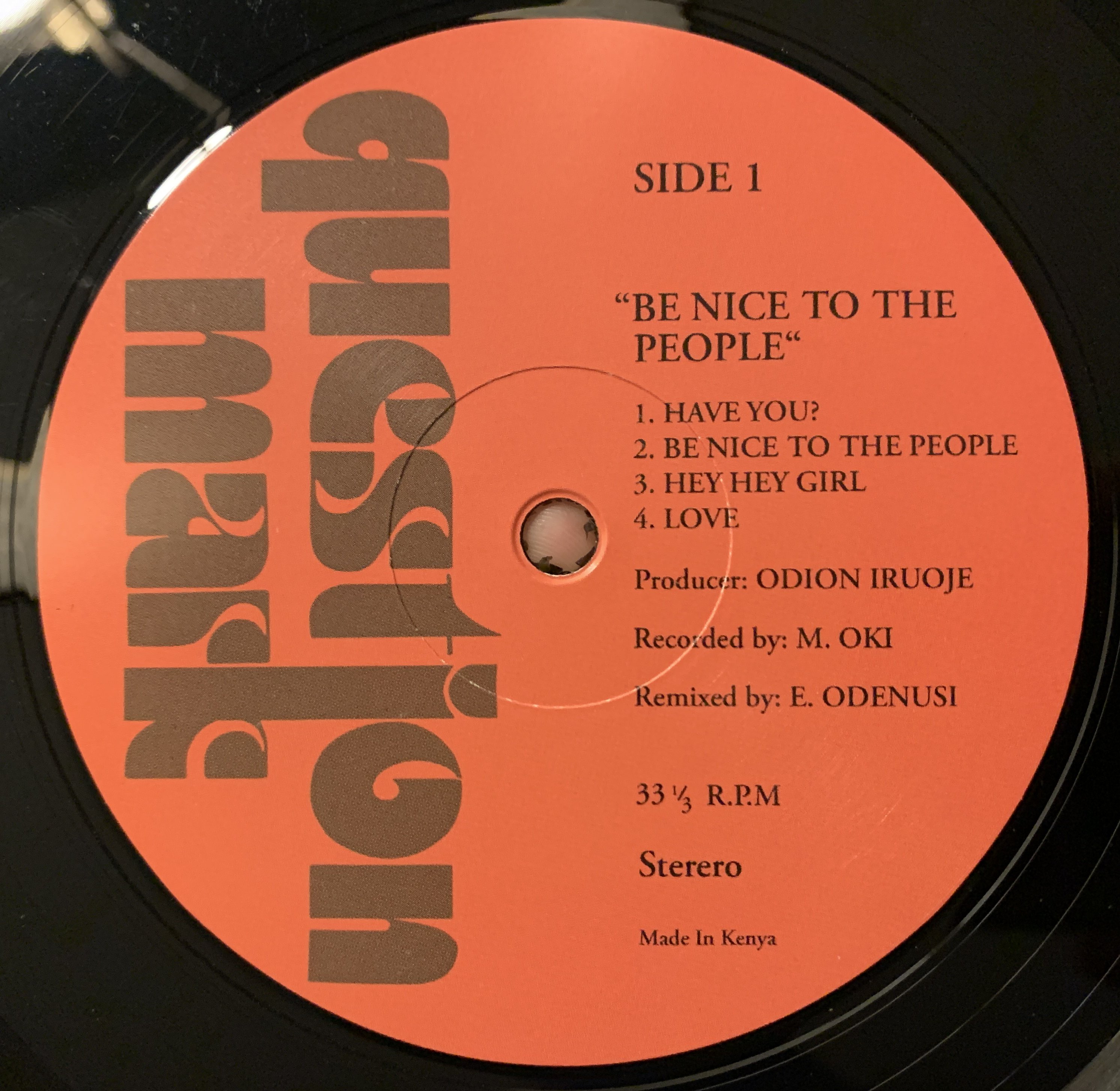
The following interview was transcribed from a Weekend Family Music Hour broadcast which took place on July 21st, 2018 on Freeform Portland. Jim (from the show Center for Cassette Studies) and I had the privilege to interview organist, singer and solo artist Frank Izuora. Izuora was a founding member of the Nigerian band Question Mark. Other members included his brother, bassist Amehi (Joe) Izuora; Chyke Okafor on drums; Uzoh Agulefo on percussion, and Victor Egbe on lead guitar. Their incredible debut release, Be Nice to the People, was recorded in Lagos, Nigeria in the mid 70s and is a masterpiece of psychedelic rock. Released by EMI’s Nigerian subsidiary, it was produced by the legendary Odion Iruoje, talent scout extraordinaire and the man behind the board for Ofege’s Try and Love and The Last of the Origins, C.S. Crew’s Funky Pack, Butley Emeka Moore’s Kiss & Smile, Apples’ Mind Twister, and literally hundreds of other Nigerian recordings that today inspire music aficionados around the globe. 

Original copies of Be Nice to the People are highly coveted and rarely show up on the used market. Shadoks in Germany reissued a limited vinyl release in 2007, which is how we came to know of it. A CD reissue came out several years later. Similar to Ofege, Be Nice to the People is known for its driving fuzz guitar passages and catchy rhythmic grooves, one-upping the UK hard rock scene at its own game. But Question Mark had a progressive pop lyricism that their peers lacked, an ability to craft ballads about the goodness of love and the importance of compassion and humanism, songs that, rather than being breathers between big guitar jams, are ones you would put the record on for. At the forefront of this unique sound was the voice and organ of Frank Izuora.

Izuora currently resides in Houston, TX, and he is still writing and composing music. He has a current recording available on Amazon called, Cruise Out.

He is also counselor who specializes in working with couples, families and children. Frank is a warm soul and multi-faceted human being whom we adore, and we are deeply thankful to him for granting us this opportunity.


Karen: How did Question Mark form as a band?

Frank: We formed our band through our social networks. Much like a domino effect, the one person I knew very well was my brother who was a bass player. I went to the same school my father went to, Dennis Memorial Grammar School. There was a young guy who played soccer there named Chyke, and his last name was Okafor. His nickname was Chykzilly. He knew I played guitar and the keyboards. He in turn knew Ekelaw Uzoh –I know it’s hard for Americans to pronounce African names because it can be jaw breaking! — so from there we formed a band. We knew an engineer in Enugu, his name was Goddy, sort of like Godwin. We went to his studio and recorded some sample tracks, and while we were there, we met Victor and he played lead guitar for Question Mark. So I played keyboard for the band. From there we got together: Joey, myself, Chykzilly, Victor, and Uzoh and we formed the band Question Mark.
Karen: How did you get signed by EMI?

Frank: It’s interesting because I knew Chykzilly who knew Uzoh, and Uzoh who was a congo player and percussionist; he had contact with EMI recording studios, so through Uzoh we met this guy and we started talking about our songs. He said we sound good enough and we did some recordings, so that’s exactly what we did. 

Karen: Was it produced by Odion Uroje, I think he was the talent guy for EMI, I think he also was the producer for Ofege? 

Frank: Yes!

Jim: Did you spend some time in the U.K growing up?

Frank: Yeah, we have an in interesting family background. My father went to London and took the whole family, including my mother, myself, and my only sister and my two brothers. We sailed on an ocean liner. Back in those days it was quite popular and flying in an airplane was quite expensive. So we went on an ocean liner which took us about a month to get there from Nigeria. Along the way we stopped in various countries. In 1960 we got to London and spent 6 years there. I went to school there. I just got back from London recently and I went to my old elementary school. We were there from 1960-1966 and returned back to Nigeria. When I was in London I was exposed to the Rolling Stones and the Beatles at a early age. I was tuned into all the stars that were around, like Elvis Presley. We returned back to Nigeria in 1966 and 4 years later I seriously started to learn how to play the guitar. From there I met other musicians and played in garage bands and honed my skills and then met Question Mark band members much later. 

Jim: If I could be in the U.K, I think 60-66 in terms of music would be a great time to be there. 

Frank: Yes! I remember a competition between the Beatles and the Rolling Stones and I believe in my mind, The Beatles won. When I hear my music I think of old girlfriends or analogies like that. 

Karen: Have people tried to contact you prior to us about your music, or asking if Question Mark would get back together?

Frank: I was talking about that to my brother, you know that’s 30 years ago and the drummer is dead and it’s like getting the Beatles back together again, you can’t. Chykzilly passed away a number of years ago. The percussionist Uzoh is actually here. He’s the guy sitting on the extreme right of the album cover with afro hair and Chykzilly is the guy beside him with his arms crossed. Uzoh is a professor in Dallas at a university. Who knew he would end up being a professor…but the track “Hey Hey Girl” was one of the few tracks we wanted to remix. We were all living on school campus and we decided to go to EMI studios in Lagos to record these songs. We all got into a car and drove 8 miles to Lagos to record Be Nice to the People. We were supposed to have spent 3 days recording the album but we just spent a day and a half. We were rushed and a lot of things we wanted to remix such as the drums, some guitar parts and vocals; we had to rush back to high school, coming back on a Sunday so we had no time. It’s like when you hear on recordings, certain areas need tweaking, so when I’m relistening to my music I say, here it comes. Oh it’s that part needs changing! Where today’s artists their perfectionists who spend 2-3 days. We spent a day and a half on ten songs. 

Karen: The lyrics are so great on Be Nice to the People and Didn’t Want to Lose You

Elizabeth Izuora (R)

Frank: Interesting because in the song, “Love,” the lyrics were not my lyrics, they were written by my sister. She was a child prodigy who passed away. She spoke 3 languages, she was a bass player, she played classical music like Mozart and Handel. When you listen to the lyrics of “Love,” it has a lot of substance and so she wrote that and I didn’t sing it. My younger brother Joe sang it. As I said I just visited Joe in London and we were listening to Question Mark because your show wanted to interview me. So we were listening to the entire album in the car on CD and like most musicians they are very critical of their own work; more so than listeners. So when Joey sang the words, “Love was really out to hurt me,” I wasn’t really a lyricist. I’m a very spontaneous person, where if I see something right away, I will write words about it. My sister Elizabeth would put a lot of thought into how to write a song. I admired her for that. Now that I’m a therapist, I put a lot of thought into my words, like when I see my clients or play with other musicians I am not trying to overpower them, I’m trying to blend with them. It’s all about harmony and the give-and-take and relationships and everything you do in life. I was supposed to have sung that song, and it was really late at night in the studio. We convinced my brother Joe to sing that song. He said “I’m not a vocalist” and I told him he would go down in history. He was tired, so tired. 

Karen: Did you guys tour very much as a band apart from recording?

Frank: We did, we played at parties, we opened for BLO and we played on TV. My mother was a director at a TV station in Enugu in the eastern part of Nigeria before the Biafran war she was in charge of a TV show called Curtis Club, which featured young people who could sing, dance, play the piano or tell stories. We went on that talent show and performed for the first time. That was the first time we played live. We thought we can go in there and tear the place down. As soon as we saw the camera rolling and hear the producer say you’re on the nervousness sets in. It’s a lot different performing live than being in a recording studio. 

Jim: Did you guys attend a music school like Ofege?

Frank: No, my sister and I had an Italian music teacher strictly for the piano who was hired by my parents. Unfortunately, I think I had ADHD or something because while she was teaching us I could hear my friends kicking the soccer ball so I went to join them instead. My sister learned to read music and play piano. I never really gave myself the opportunity to read and write music. I learned strictly by ear. I learned how to play the guitar for all the wrong reasons after seeing how he attracted girls when he played music. So I had my friend show me a few chords, I started to listen to Beatles songs again and rehearsed guitar parts and then used my own creativity to produce something similar. You can hear some of that in Oh My Girl. I didn’t play guitar on that track but I showed the guitarist what to play. There was no one who could play the piano, so I took that instrument.

Karen: How did your solo record come to be?

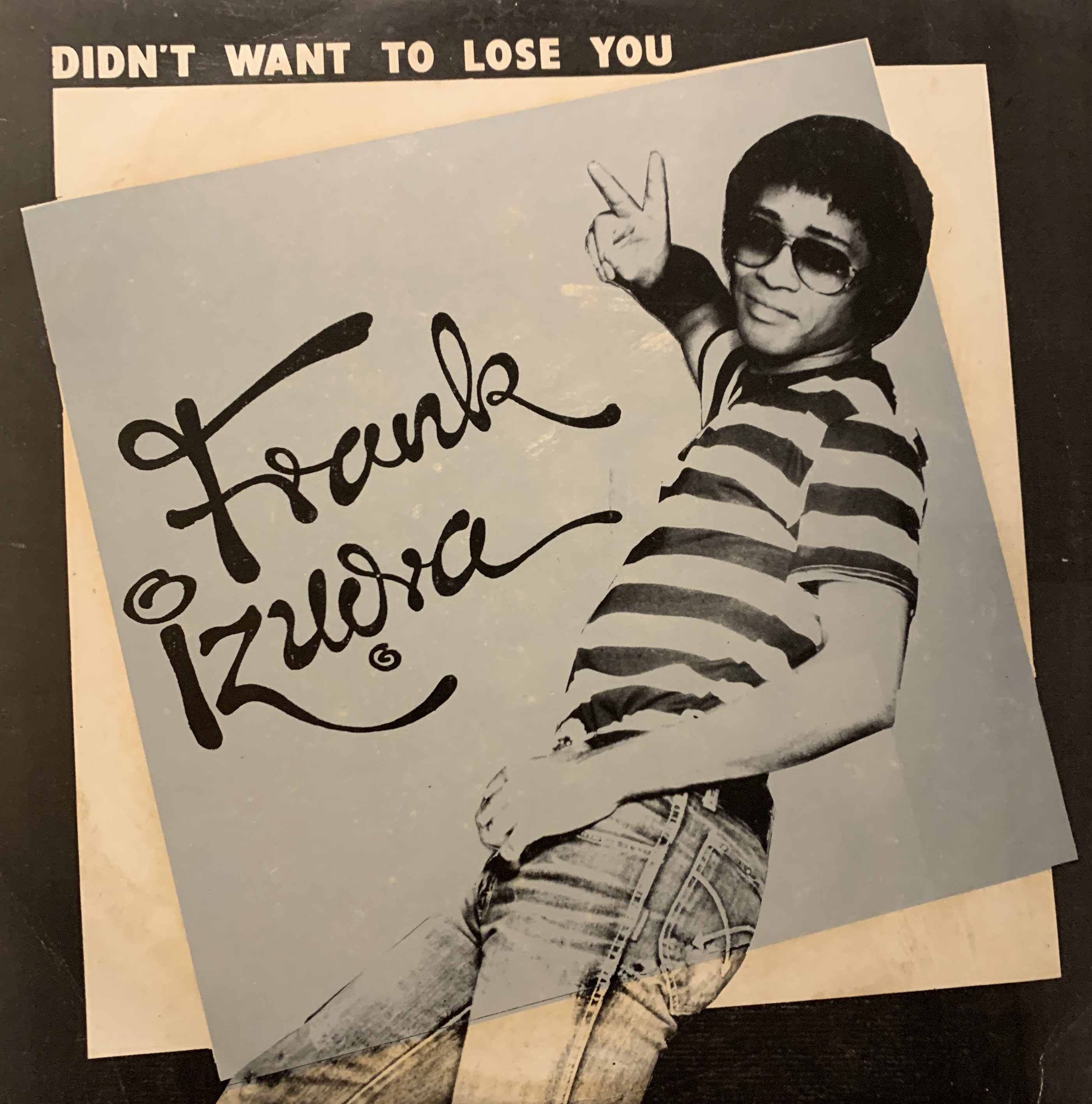
FI: I left Nigeria and came to the States in 1977 and I went to Buffalo State College in Buffalo NY. I returned to Nigeria in 1982 and recorded a solo album. I played all the instruments and did it myself, I decided to quickly write songs and practice. The producers at the TV station where my mother worked on the talent show heard me playing so he started helping me out in recording my solo album. I wanted to record my album before I headed back to Buffalo. So the producer helped me. So I went to meet a guy, Goddy Oku–Oku in Nigeria means fire or light in English. He had a band called the Hykkers who were known in eastern Nigeria. So I went to Oku’s recording studio with them, and it took quite some time recording my album but I got it all done before going back to college.

Karen: Didn’t Want to Lose You was also pressed at Wilfilms, which was William Onyeabor studio. So you’re giving us an incredible history lesson…

Frank: I can tell you a whole lot more. It’s very interesting history, do you guys know about the history of the Nigerian Biafran War? Well, my mother knew the head of state Ojukwu, so when Nigeria broke away, he was aware of our band. He purchased instruments for us and at the time we were not Question Mark, we were The Questions. In The Questions my sister was playing the bass guitar and my cousins who were my mother’s half sister’s daughters were on vocals. So through Ojukwu after buying us instruments he flew us to Gabon during the Biafra war to perform for the president of Gabon. I think his name was Bongo something, he was a really short guy, he was sitting on a couch and his feet barely touched the ground and I was telling myself, he’s the president of a country…We performed to raise money for the troops and we were flying there on a relief plane and they were shooting at us in the plane we were flying in. We actually raised money for the troops and we evolved from Question to Question Mark and then we performed for the first time on TV on the talent show.

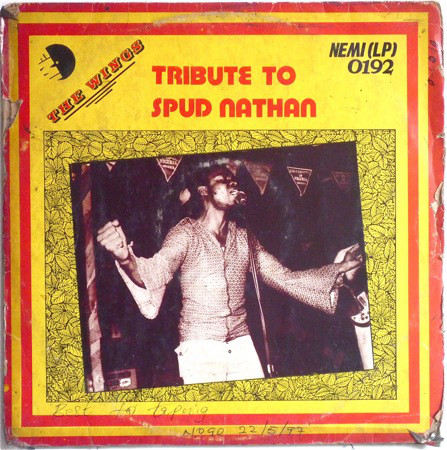
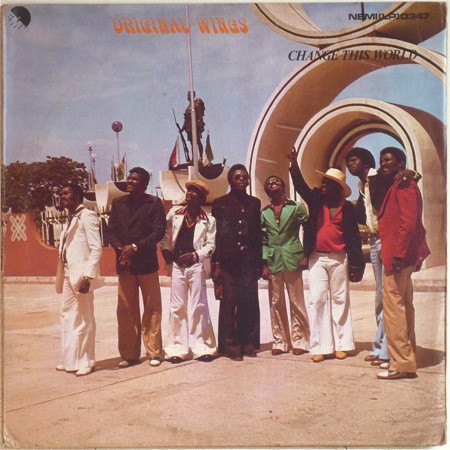
Jim: There was another band called The Wings who also performed for the military….

Frank: My mother knew them as well. My mother knew quite a few bands that helped us we knew bands who rehearsed and played through the war, we rehearsed in a garage with a band called The Fractions. 

Karen: Have labels contacted you about reissuing Question Mark?

Frank: I think I could have done things differently, at that time about 9 years ago they had us sign papers and they reissued that. I still own the rights to my own solo record. The song “Freaking Out” and the story behind that song. My father’s brother who was a doctor and musician in the Army returned from Germany, he played music for the fun of it. He returned with a bass guitar and my brother Joey played guitar and he had an amplifier. He gave us his bass as a gift and I looked at my brother and he looked at me and I said, hey let’s freak out! And so we wrote and titled the song “Freaking Out”. 

Karen: Now Again reissued Freaking Out and Scram Out on their compilation Wake Up! Is it strange to hear your original record is worth quite a lot now?

Frank: Yeah! Remember that old phrase, one man’s trash…when we recorded these songs I wasn’t thinking of business. We were having fun. I think sometimes when you feel what you do isn’t really all that valuable. I think as human beings we don’t stay put and life is a journey. You improve who you are as a person, musician work on your style and keep on making progress. It fills my heart with pleasure/appreciation to hear that people appreciate the music I have made many years ago. If the whole world could appreciate each other it would be a better world. 

Karen: Through your music and lyric writing I hear how much positivity you have…

Frank: Music is my first love and I am a musician first. I am also a LMFT (Licensed Marriage Family Therapist), I’ve run into people who have so much emotional stress and through my profession and my personal life I’ve come to realize that when a person loses a sense of self and purpose, I try to come in and show them who they are and bring that out, and gain self esteem. When I was young I was extremely shy and when I tried to talk to girls, I would write down things to talk about. I would call them on the phone and then drop the phone because I was so nervous. I’ve realized it takes two to make a relationship. It inspired me to write songs to appeal to both sexes and inspire people.

Karen: What are your musical projects now?

Frank: I’m working on some new material. I have a new instrumental album called Cruise Out. I am also working on a new vocal album that will have some lyrics that reflect the same philosophies I have. My songs are going to make people appreciate life and have a really good time. When I get through with my new songs, I’ll let you guys know.

Karen: Would you ever tour Didn’t Want to Lose You?

Frank: I would tour in Portland, OR if I can get back up musicians. I’ll think about it and figure out a possibility to have people play old and new stuff. I left London and I was talking to Joey about people wanting to interview me. I ran into musicians on the plane, people who played with Heart and Bad Company. It was a coincidence and I think there is some positive karma going on right now. Hopefully one of these days I get to meet up with you guys, as we say in Nigeria, eyeball to eyeball.

Nigerian Pop and Disco Women Singers

Screen Shot 2019-02-15 at 10.37.18 AM


by Jim

The very start of the 1978 liner notes for Grace Ekpeyong’s Morning Prayer puts it bluntly: “Although the Nigerian entertainment industry, especially the musical sector, has grown enormously over the past two decades, the incidence of outstanding female performers on the scene remains rare and isolated.” Women were often on backing vocals, transforming good records into great ones in the process; see William Onyeabor’s “The Moon and The Sun,” The Wings’ “Someone Else Will,” or anything on N’draman Blintch’s “Cosmic Sounds” record. If they assumed a headlining role, it was sometimes through collaborative partnerships with musician spouses (Grace and Jack Ekpeyong) or through family in the industry (Lorine Okotie, sister of Kris). Joe Ngozi Mokwunyei was already a young academic when she recorded her landmark Boys & Girls LP in 1979, as Joe Moks. Many point to the success of Oby Onyioha’s breakthrough I Want To Feel Your Love in 1981 as the big tipping point. From the pre-80s era, the most well-known Nigerian women singers outside of the country were probably the Lijadu Sisters and Christiana Essien. Essien was a teenage T.V. star when she recorded her first LP Freedom for Anodisc in 1977. The Lijadu Sisters were perhaps culturally acceptable because harmonizing sisters often get a societal pass. By their own account, gender bias and exploitation played a role in their acrimonious split from Decca’s Nigerian subsidiary label Afrodisia, in 1980.

Biographical details are scarce to non-existent. I have linked to the best YouTube rips I could find and noted any good reissues. I am just an amateur fan so please forgive any errors, poor assumptions, or general ignorance on display. A shout of gratitude to Nigerian pop music experts Uchenne Ikonne and Temitope Kogbe for graciously answering questions via email and for all they have done to get many of these great records re-issued and broadly exposed.  — Jim


Sandra Smith Izsadorefela-sandra-400x400

It’s ironic that women artists are absent from Nigeria’s early afrobeat scene given that it was an African-American woman in California, Sandra Smith (now Izsadore), who had such a profound impact on its most renowned male figure, Fela Kuti. According to drummer Tony Allen’s autobiography, when they toured America for the first time in 1969, it was she who turned Kuti on to the importance of black nationalism, colonial history, and cannabis. Sandra was a turning point in Kuti’s sense of political identity, the one who, in his words, “Africanized” him. After her influence, his records became sonic attacks on western dominance, augmented by Lemi Ghariokwu’s anti-imperialist art design. And it is Sandra’s voice that forms the centerpiece of my favorite Kuti side, 1976’s Upside Down, credited to “Sandra Sings With Fela & Africa 70” and recorded during her 6-month stay at Kuti’s commune, Kalakuta.


Bola Onagoruwa & Ukachi “Ukay” OfurumR-8077500-1491251589-1788.jpeg

Some contributions by women on records headlined by men were transformative. Such is the case with the first LP from Grotto, At Last…, which was issued in 1977 by EMI Nigeria. According to its liner notes, Bola and Ukay were classmates of Grotto’s guitarist and composer Martin Amenechi, at St. Gregory’s College. During a second session of vocal overdubs in December 1976, they were invited to participate, recording over the previously laid-down men’s vocals. Bola’s classic lead on “Come Along With Me,” the album’s opener, is a mesmerizing collision of musical influences. Likewise, Ukay’s contributions to “Grottic Depression II” and “Change of Tide” helped elevate this LP to a new plateau of afropop greatness. Check out “Funk From Mother,” where both Bola and Ukay trade off lead vocals with male members of the band. Original pressings rarely surface and fetch hundreds of dollars when they do. Luckily, At Last… was just re-issued by Odion Livingstone, a Nigerian label run by Odion Iruoje, the original producer, and Temi Kogbe, a record collector and DJ. Highly recommended.


Mary Afi UsuahR-9172736-1476040976-3130.jpeg

Classically-trained singer Mary Afi Usuah released several beat singles for the Italian market, as Mary Afi, before returning to Nigeria to record two highly-regarded LPs. She is one of the few artists here who has received a stand-alone reissue in full, courtesy of archivist (and former Usuah pupil) Uchenna Ikkone; all should seek out Ekpenyong Abasi, her first LP with the South Eastern State Cultural Band. She later released African Woman on Clover Sound, which I have yet to hear. From the first record, the slow escalation of “From Me To You” is six soulful minutes of power, strength, and sadness. “Mma Ama Mbo” is also a must.


Joy NwosuScreen Shot 2019-06-13 at 11.25.29 AM

Like Usuah, Joy Nwosu studied voice in an Italian conservatory, initially researching African cinema and writing a book on the topic in 1968, entitled Cinema e Africa nera. She then returned to Nigeria and began recording a mixture of her own compositions and new arrangements of folk songs, which became Azania on Afrodisia, her most popular release. Among its standout vocal accomplishments are “Egwu Oyoyo (Oyoyo’s Dance)” and “Ile (What the Tongue Can Do).” The A-side of a 7” single released just prior was included on an anthology called Nigerian Blues 1970-76. Nwosu later became an academic in ethnomusicology, holding a faculty post at University of Lagos, where she admiringly butted heads with its chauvinistic patriarchy. An accomplished author, she now lives in New Jersey. A fantastic 2014 interview with her can be found at the African Women in Cinema blog.


Christy Ogbahimage4

Christy Ogbah recorded three stellar LPs in her career that I know of: two for Duomo (pop) and a third for Mosokam (highlife), which is credited to Christy Ogbah & Her Melody Group. While best known for her wall-of-fuzz dance track “Advice”–her only English-language song–Ogbah excelled at slower synth-heavy pop, sung in Esan, that was strictly neither disco nor funk but a far more fascinating mashup. Songs like “Iyiye” and “Iyebhado” become plodding loops of multi-tracked vocals and melodic Moog accents, a sort of odd boggie-drone. At times, her layered voice sounds almost like a synthesizer. The 1980 LP Advice, packed side to side with deep hooks, is my fave Duomo release (its three best tracks are on Odion Livingstone’s indispensable 2017 Duomo Sounds Ltd.) Its follow-up, Iziegbe, shows Ogbah further exploring intersections of highlife and Lagos disco, melding the hybrid sounds found on her first two recordings. According to the liner notes of Duomo Sounds Ltd., she was a police officer at the time of these recordings.


Joe Ngozi Mokwunyei (Joe Moks)image2

Comb & Razor put the song “Boys & Girls” on their superb Brand New Wayo anthology, which led to its rapid spread through DJ disco sets around the world. The track was taken from Joe Moks’ LP of the same name, released on Afrodisia in 1979. Like Ogbah’s Advice, it is a synthy dance bomb from beginning to end, meticulously sequenced and arranged by Moks and Tony Okoroji, without a bad track. Apart from the title song, “Being In Love Is Being Involved,” “Closer Than Skin,” and “Insure My Love” are all particularly outstanding. Today, Dr. Mokwunyei continues her teaching and research at the University of Benin, specializing in subsects of Nigerian musicology, most recently among the Anioma and their use of a woodwind instrument called the akpele which serves as a melodic surrogate for the human voice.


Grace Ekpeyong (Grace Jackson ‘E’ & The Galaxy)image7

Ekpeyong started off as the lead singer for an all-girl Army band called The Tranquilizer in 1975, but they broke up later that same year. She then met and married bassist Jackson Ekpeyong, with whom she assembled her fantastic backing band, The Galaxy. Her first EMI LP Morning Prayer from 1978 unfortunately lacks band credits but elements of The Galaxy already sound in place. Standout tracks are the two “think” songs closing each side, “Think of Tomorrow” and “Think of Yourself.” So many of her songs are philosophical, socio-political statements that somehow transcend time. The three EMI records that followed throughout 1979-80–Don’t Treat Me Like a Fool, Woman Needs Love, I Need You–are all full of addictive melodies and electronic sounds. DTMLAF is arguably the best of the three (Mike Umoh on trap drums!) and includes the trancey title song, the conflict-resolution epic “For Better for Worse,” and “Give Me Your Love.” Woman Needs Love is more reggae, simultaneous released in Nigeria on EMI and France on Pathé. I Need You is ballad-centric and melancholy, with great use of Moog accents, as with DTMLAF, courtesy of keyboardist Coll. Jonas. In 2014, the lead cut from WNL, “I’m Gonna Get You,” was bootlegged onto a 7″ by Ximeno Records, albeit in edited form.


Helen NkumeR-9244339-1477254203-7601

There were several great women bandleaders in Nigeria in the 1970s. In the southwestern jùjú scene of the Yoruba, Lady Balogun & Her Famous Brothers Band and electric guitar genius Queen Oladunni Decency & Her Unity Orchestra reigned supreme. One of their peers was Helen Nkume, who also recorded under the name Helen Williams. The only album I have heard of hers is called Volume IV, recorded with Her Young Timers for Utimo Records in 1978. All four of its tracks are outstanding but the best is likely “Music”, the breakneck fuzz-filled dance bomb that closes out the first side. (EDIT: Volume IV just reissued by Dig This Way)


Commy Basseyimage8

It was South Africa’s Miriam Makeba whose beats exploded into the European market in the 1960s, with her worldwide hit “Pata Pata” being covered by women artists from Italy, Yugoslavia, Hungary, and France. She became a pan-African source of pride and inspiration for women, as evidenced on the lead track “Great Miriam Makeba” from Commy Bassey’s first LP, In Solitude, released in 1978 on Clover. Bassey wrote and composed all but one song, with Original Wings guitarist Charles Effi Duke helping out with arrangements. Her voice was deeper than others on this list, with a unique drawl, both single and double-tracked. Although In Solitude suffers somewhat from Clover’s claustrophobic production sound, the performances are solid. “Pretty Angel” and “Smiles” punctuate rhythm with silence. But it’s the lead on Side 2, “Looking for My Man,” that’s the big jammer. Anodisc’s Let’s Dance, released two years later, saw Bassey finding her niche in the disco scene and offers up such essential clap-heavy grooves as “Now That I’ve Found You,” “I Need Someone,” “We Want Togetherness,” and “Let’s Dance.”


Eme BallantyneScreen Shot 2018-10-03 at 9.19.29 AM

From all accounts, Afrodisia had a bad habit of signing artists, releasing one LP, and not offering much in the way of follow-up, promotion, or helping them get established. This might have been the case with Eme Ballantyne, an obscure singer for which I can find no information. Her sole LP is called Remember Me, which came out in 1981. The piercing timbre of her double-tracked voice as it repeats “My life is like a rainbow in the sky” throughout the opening ballad “My Life” manages to sound both old and contemporary at the same time.


Carol BridiR-1625693-1232991322.jpeg

Carol Bridi’s synth-groover “Shake The Dust” comes from her debut LP called One Family, which was released on an indie label called Otto Records at the height of the Lagos boogie explosion, in 1984. Other standout performances include “Where You Are” and “Soul On Fire.” The crisp spacey sound owes much to the wonderful engineering and production of George Achini and Remy Njoku, who also worked with such greats as Esbee Family, Bassey Black, Christy Essien, and Oby Onyioha.


Christiana Essienimage11

Already known for playing a beloved character on a popular Nigerian TV series, Christy Essien branched off into recording in 1977, with the nearly-perfect Freedom on Anodisc, whose uncredited band likely backed Tex Soul on his superb The Vibrations project that same year. In addition to the title jam, “Mr. Boom Boom Boom”, “Feel So Good Sometime”, and “My Kind of Man”, it contains two great slower tracks, “I’m No More Your Little Fool” and “If I Can Be Free From Darkness.” Patience followed, before a move to the Blackspot label for Time Waits For No One. Decca then picked her up for her two most popular records, One Understanding and Give Me A Chance on Afrodisia, the former featuring parts of Pino’s Heartbeats. Her sixth release, Ever Liked My Person?, was the biggest success of her career and saw her moving towards a more polished (but less funky) sound. She later became the founder and first woman president of the Performing Musicians Association of Nigeria and was involved in social advocacy causes for women, including against female circumcision.


Doris Ebongimage1

Apart from her music, I know next to nothing about Doris Ebong. She recorded one colossal LP for Phonodisk in 1982, All I Need Is Your Love, produced by Tony Essien and with songwriting credits split between the two of them. Ebong’s own contributions, or the ones that she co-wrote–like the frenetic “Disco Drive” and the ground-shaking “I Won’t Let You Down”–are the album’s shoulda-been megahits that today fill dancefloors worldwide. The Shirley-Ellis-meets-Catfish-Collins instructional “Boogie Trip” was the mind-blowing centerpiece of the Lagos Disco Inferno compilation a few years back, which is essential listening. Willy Nfor’s exceptional bass playing graces all tracks.


Mona Finnihimage6

Mona Finnih recorded three collaborations with former Aktion and MonoMono guitarist Jimi Lee. The first and best, EMI’s A Stroll In The Moonlight from 1980, is a wonder to behold, packed with horn-heavy tracks like Lee’s majestic funky title cut, Finnih’s “People of the World,” and her pounding tour-de-force of empowerment “I Love Myself.” In 1984, they released Almighty on Afrodisia and Eni Ma Bimo on Emona. More highlife than disco, Lee’s “Iwa Ika” is the standout from the latter, a tight swirling mass of percussion, Hawaiian guitar, saxophone accents, and multi-tracked vocals. In 2014, Voodoo Funk compiled two of her best tracks from the Moonlight LP onto a 12” release.


Eunice Mokus Arimokuimage5

Like label-mate Christy Ogbah, Eunice Mokus Arimoku was affiliated with the early-80s Lagos club scene. Her first record was on Duomo, Onye Oni Me, while her second was self-released five years later on her own label, Unimokus Records, called I Am Glad You Are Mine. The track “Loneliness” from the latter is her big jammer, a loud echoey sprawl of voice and synth over a single looping guitar signature. From her first LP, “Ariro” is a standout, recently anthologized on the Duomo compilation from Lagos-based Odion Livingstone. Her powerful multi-tracked voice propels all of these songs forward in profound ways that I can’t articulate.


Oby OnyiohaScreen-Shot-2018-05-30-at-2.11.32-PM

Onyioha’s acclaimed I Want To Feel Your Love represented the launch of a new era for women artists in Nigeria. While industry prejudices remained, a steady stream nevertheless began changing disco conventions and embracing a more mellow 80s dancefloor sound. Time, Tabansi, Phonodisk, and Taretone all began to sign and record more women artists, like Stella Monye, Lorine Okotie, Julie Coker, and Martha Ulaeto. Onyioha recorded a second LP in 1984 on Sunny Alade, entitled Break It, but its success failed to match I Want To Feel Your Love. While you can’t beat the driving force of its title song, I’m partial to “Enjoy Your Life,” the smooth swinging side closer that includes a line about “humpty dumpty stuff” that I can’t ever really make out due to the cool jabby synth pan. Check out the compilation Doing It In Lagos from Soundway for this track and others. She’s now an anthropologist.


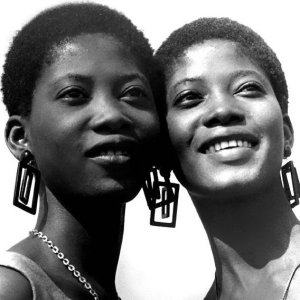
Lijadu Sisters47fa1b37e5904d47a62990fdc6c6847a

Lastly, there isn’t much I can add to the story of Taiwo and Kehinde Lijadu. The talented twins toured the world and knocked out a string of flawless records during the latter half of the 70s: Danger, Mother Africa, Sunshine, and Horizon Unlimited. While Danger is usually the fan fave, be sure to check out “Set Me Free” and “Reincarnation” from Sunshine. Instead of a song, I’m linking to an incredible documentary clip from 1980 that finds them grappling with the exploitation they’ve experienced at the hands of Decca’s Afrodisia label, but also optimistic about the roles for women artists moving forward. “It’s only this industry that has a problem of a shortage of female artists…I wouldn’t be surprised in the next five years if we don’t have more females in this profession than men.” LISTEN

Val Wilmer is Seriously as Serious as Her Life

By Karen Lee

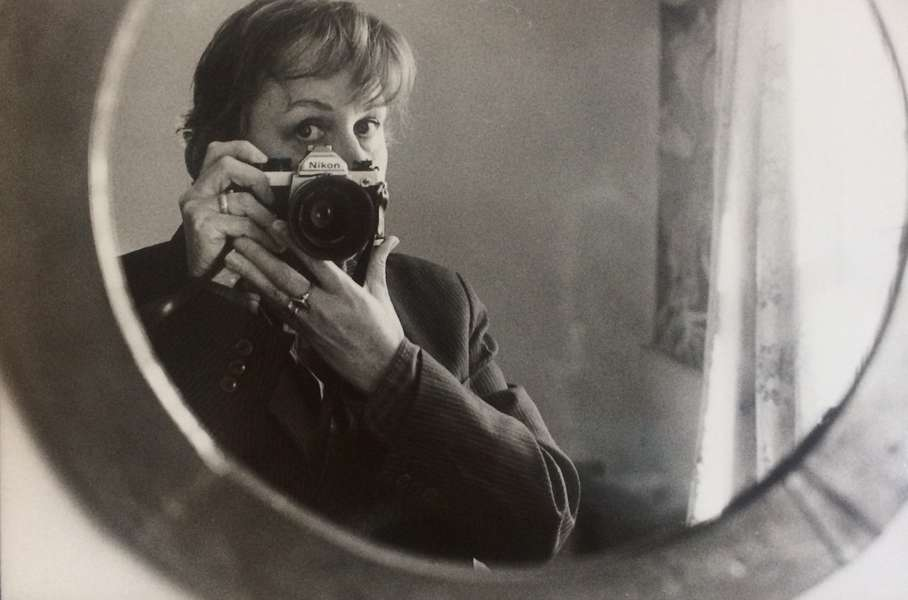
Valerie Wilmer was born in Harrogate, England Dec, 7th 1941. She is an English woman, photographer, jazz/African, Jamaican West Indies music historian/archivist, writer, lesbian and feminist. She has written for Jazz Journal, Mojo, The Wire, Jazz News, The Oxford Dictionary of National Biography, The British Library Sound Archive and The Guardian, as well as many other jazz/music publications. She is the author of Jazz People (London: Allison & Busby, 1970; Indianapolis: Bobbs-Merrill Co., 1970), The Face of Black Music (New York: Da Capo, 1976); As Serious as Your Life: The Story of the New Jazz (London: Allison & Busby, 1977) and her autobiography Mama Said There’d Be Days Like This: My Life in the Jazz World (London: Women’s Press, 1989).

Wilmer and her brother Clive were raised by a single mother, who rented rooms from their London house to pay the bills. Wilmer’s mother was supportive of her blossoming interests in jazz music which began in her teens with the book by New Orleans Jazz enthusiast and radio deejay Rudi Blesch, Shining Trumpets: A History of Jazz. At a young age, Wilmer immersed herself in jazz and African American/international music culture before it was embraced by mainstream culture. She frequently brought home jazz musicians who were mostly male, black and international to have tea with the family, and, as a result, the house soon became a known jazz performer destination in London to visit while on tour. Harry Carney, who played baritone sax with Duke Ellington’s band, sent them Christmas cards every year. Jazz pianist Randy Weston would stay over to talk about Africa and Nationalism while eating a breakfast of bacon and eggs. The Ambassador for Liberia invited her mother to champagne parties (Neglected Books, 2016).

Wilmer’s life as a white female gay critic in the 1960s and 1970s juxtaposed the conventional media coverage of race with the empowerment of people of color and women as captured through her personal lens. The early women’s liberation movement then flourishing in the United States also influenced the U.K., and Wilmer became politically involved with women’s empowerment, organizing Take Back the Night events in the late 1970s in London to bring awareness to sexual violence perpetrated upon women. Wilmer realized she preferred women sexually when she witnessed Althea Gibson, the first African American woman to play in professional international tennis, embrace her opponent in good sportsmanship at Wimbledon. Wilmer was never deterred when private lesbian clubs she visited were occasionally raided by vice squads because she felt it was her right to have access to such clubs without discrimination or shame:

. … because what we were doing by walking through that door was declaring ourselves — what some would call “coming out” — there was about the whole exercise a sense of terrible excitement. It revolved around bravado and ritual. Getting ready to go there was a ritual, the crease in the trousers, the eyes made-up just so Parking the car was a ritual, as near to the club as possible to avoid the voyeurs and the challenge of passers-by. Gaining entry meant mustering bravado. And for what? To spend time in a place where you could, supposedly, be yourself. 

Louis Armstrong- Val Wilmer 1961

Wilmer has lived her life always being herself and actively pursuing what interests her the most. She took her first photograph documenting Louis Armstrong with her mother’s Kodak Brownie camera and soon afterward pursued an education at The Regent Street Polytechnic in London, with a dual degree in jazz photography and writing. Her photographs have been shown in galleries in Europe and the U.S, and she co-founded the first all-woman photo agency in London, Format, in 1983 (The Jazz Image).

Wilmer has been documenting jazz artists and music history since 1959. She has countless interviews and photographs with jazz greats, beginning with Earl Warren, who was an alto saxophonist and sometimes vocalist for Count Basie and Lester Young. Her reputation as a serious critic grew following her piece on Billy Higgins and Ornette Coleman. By 1965, she was visually documenting Thelonious Monk’s progression through his changing improvisation and composition styles while critiquing the past decade of his career (Wiki).

My favorite book by Wilmer, As Serious As Your Life, first published in 1977, documents the early scene of “free jazz”, or “new jazz,” in various urban areas across the United States. It is a seminal text that chronicles the groundbreaking beginnings of what would soon become known as the Free Jazz movement.

Wilmer interviews such innovators as Sunny Murray, Sun Ra, Cecil Taylor, Rashied Ali, Albert Ayler, Bill Dixon, Archie Shepp, Marion Brown, and Don Cherry, to name a few, all of whom changed many conceptions of what “jazz” music is. She interviews jazz musicians who performed at community places, such as The Storefront Museum in Jamaica, New York, which was a converted storefront and community project in the borough of Queens. She talks to Milford Graves, an innovative free jazz drummer, comparing his compositions to the compositional brilliance of Terry Riley, and the British gay painter, David Hockney.

Wilmer’s critical comparisons often mirror the artists she is interviewing, comparing and contrasting other fringe musicians. She often combines descriptions of musical virtuosity with visual artists, to better display the dynamics of hearing free/new jazz in three dimensional concepts, to help her readers conceptualize their expanse. Wilmer appears to always be fully present in her writing about jazz or music history, portraying jazz artists in their natural environments and contextualizing the aspects of jazz intellects.

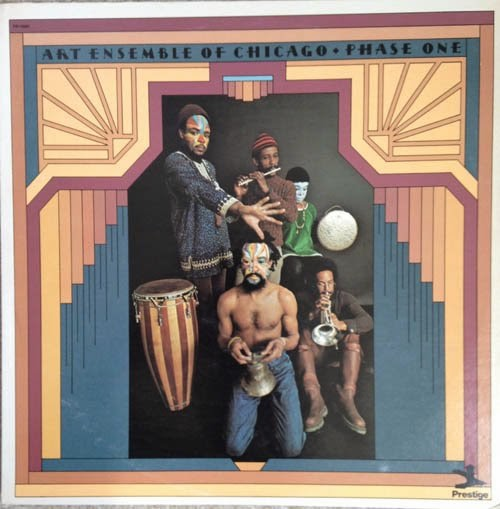
The label of free/new jazz was often condoned by the jazz musicians who were making the music, but the concept of categorization is typically based on paradigms created by white patriarchal institutions. Thus, one can argue that categorical terms like “Free/New Jazz” may limit the audience. Unfortunately, the concept of categorization is often needed to relay a style or period to draw context for     readers because of the established dominant discourse of labels. The Art                         

AlbertAyler- Val Wilmer 1966

Ensemble of Chicago explains, “It is whites who have called our music ‘free,’ we just call it music”. The Art Ensemble of Chicago was part of the Association for the Advancement of Creative Musicians (AACM). AACM became an established group in 1965 by pianist Muhal Richard Abrams; Jodie Christian; drummer Steve McCall, and Phil Cohran.The AACM was composed of four to five creative musician groups who based their creativity on maintaining their own rights and self to their music. They paid minimal dues to AACM and played concerts at different venues or places in Chicago. Cohran was a band member in Sun Ra’s Arkestra, playing trumpet for Ra from 1959-1961, until he left to pursue his own form of spiritual jazz. As Wilmer explained in As Serious As Your Life, many AACM members had always focused on the progression of jazz but some members felt Sun Ra had progressed too far out. After time, these members went to New York to seek out Sun Ra to tell him “yes” to his music, after Ra had left AACM (Wilmer, 1977).

Liner notes to Phase One- Art Ensemble of Chicago Prestige 1971 by Val Wilmer

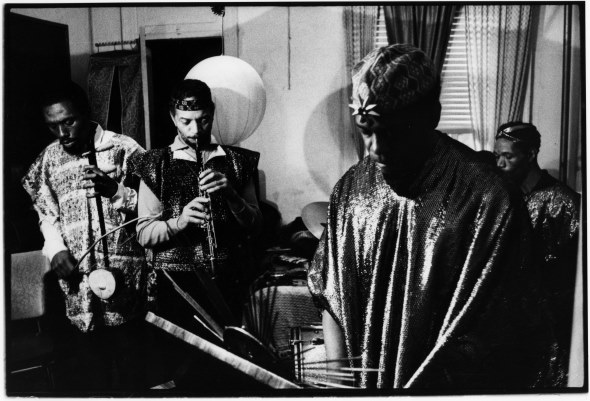
Wilmer’s photographs are mostly taken in black and white. She used a 35mm Pentax Silverline and would wait backstage or in the audience, before or after interviews, or on the sidelines for the perfect shot. Wilmer is a master at manipulating light to contrast the artists she is capturing. For example, referencing the Sun Ra photo Wilmer took in 1966, we see Sun Ra and his Arkestra in deep concentration. The group was living communally at the time, maintaining a regimen of creative cohesiveness that was rooted in the cosmic realm of Ra’s psyche. The light that plays on Ra’s sequined cloak shines and morphs into shadows on his right side, downplaying his eloquent genius. Marshall Allen stands to Ra’s left, playing oboe and complimenting the photo’s chiaroscuro lighting with infinite dimensional sounds that are heard by Wilmer at that moment, suspended in time.

Sun Ra Arkestra- Val Wilmer 1966

Wilmer is in every sense as important as the musicians and music she has documented. Music criticism is often told from the standpoint of the critic, who is usually a white male, and the criticism can be construed as flat, lacking compassion and mostly based on the judgment of the white male critic’s taste or bias. Sometimes the white male ego is accentuated in their writing, and often the emotion behind the critique lacks any form of humanism or compassion for exploring compositional pieces that are dynamic and rooted in the creative heritage of the artists they are critiquing. Wilmer is a transcriber: she writes what the musicians “tell” her, and she portrays musicians in their spaces, places and mindsets, while not impinging upon their creative narrative. She spends time with the people whom she admires, and the time she spends adds increased depth to her prolific photographs and writing.

Who In the World Was Benyamin S. (Benyamin, Bang Ben or Babe)?

By Karen Lee

I discovered Benjamin S from receiving his album Kompor Meluduk for Christmas from my partner a couple of years ago. Upon hearing it, our minds were blown from the juxtaposition of soulful, funky eccentricity with psychedelic fuzz rock, plus some swinging duets with a woman vocalist, Ida Royani. Since there was zero information on the sleeve, I was inspired to ask, “Who in the world is Benjamin S?” 

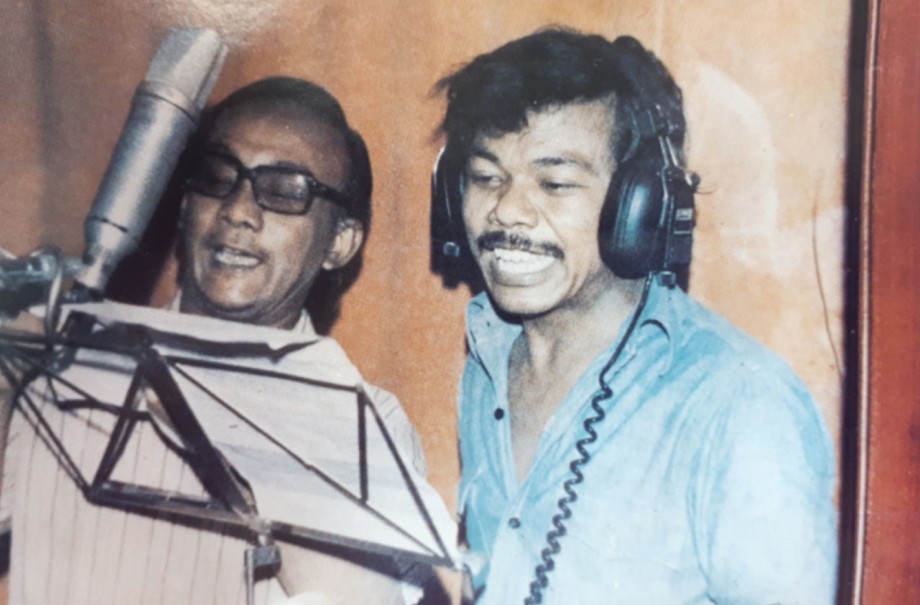
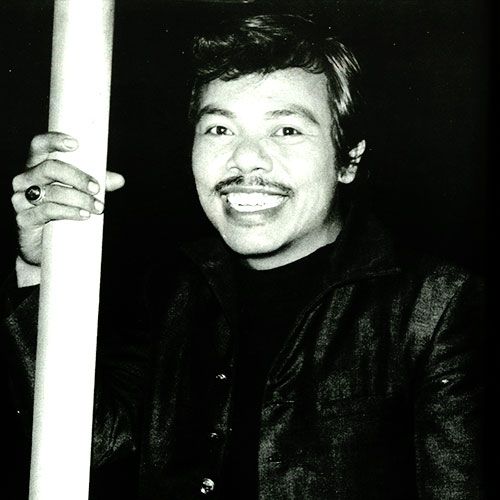
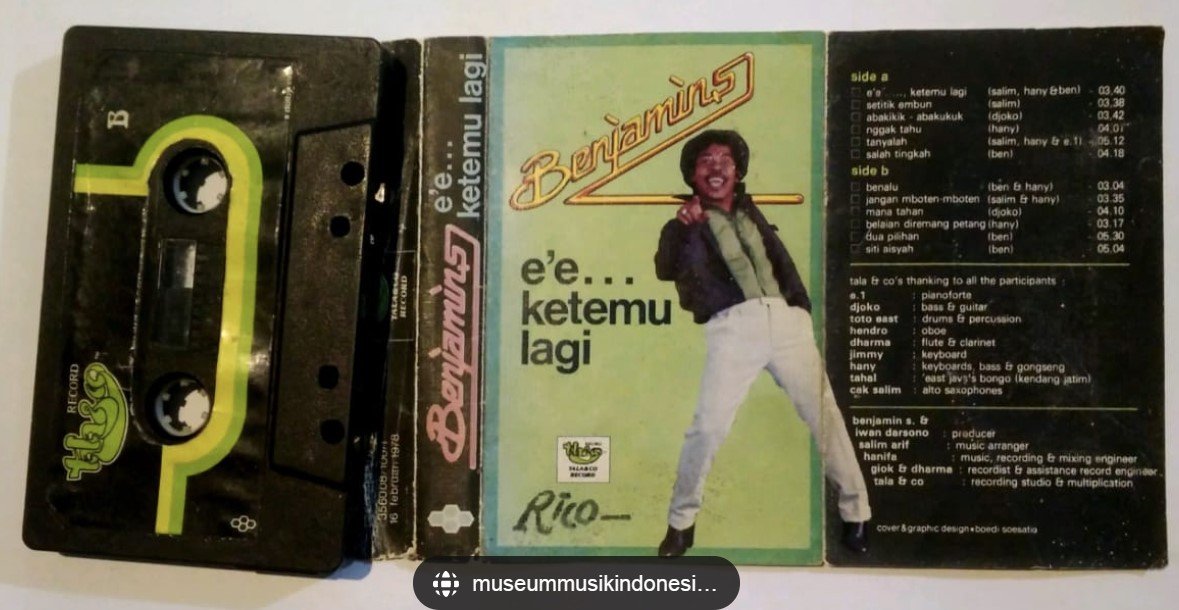
Benjamin Sueb, a.k.a. Benyamin S, Bang Ben, or Babe (March 5, 1939-Sept 5, 1995) was a prolific Indonesian comedian, singer/rapper, radio producer, director and actor who produced 61 films and 312 songs, which included 165 singles and 147 duets. He also produced 5 comedy albums, 2 soundtracks, and 10 compilations. Sueb was of Betawi descent. The Betawi are Islamic native peoples from Indonesia who are from mixed race marriages and blood lineages, including Chinese, Arab, Portuguese and Dutch colonies, from various tribes in Jakarta. Sueb was the youngest of eight siblings, born to parents Siti Aisyah and Sueb in the Utan Panjang Kemayoran village. Unfortunately due to poverty, the Sueb-Aisyah siblings lost their father when Benjamin was two years old, and he took it upon himself to be an entrepreneur at the age of three, busking in his village to pay school fees and buy/barter food to help feed his family. Entertaining may have come naturally to Sueb, being influenced by grandfathers Saiti, who played clarinet, and Haji, an Ung Dulmuluk player who performed at Indonesian folk theaters in Dutch colonial times (Wiki). 

Sueb was a charismatic, curious and inspired child who had many friends. His small appearance enabled him to attract audiences from an early age. He formed a “canned” orchestra with his brothers in third grade, where they would bang on cans using stems from kebabs and biscuit tins. Once in high school, he joined a school band named the Melody Boys. The Melody Boys played song styles which included dangdut (traditional pop derived from Arabic, Hindustani and Malay) and gambang kromong, a Betawi gamelan music played on a ukulele-type instrument, and also a type of off beat/pentatonic scale music played by orchestras in Indonesia, with two ukuleles, guitar, cello and bass. He also played Western music incorporating cha-cha, jazz, rock and blues imported by Indonesian musicians such as Bill Saraghi, Jack Lesmana (guitar player), and Rachmat Kartolo (singer/actor). Sueb performed with Saraghi and Lesmana at the Hotel des Indes, singing Western hits such as “Blue Moon,” “Unchained Melody,” and “When I Fall in Love.” In the 1960s, the Indonesian government issued a ban on Western propaganda and routinely interrogated artists who played Western songs and failed to conform to societal standards. To navigate the sociopolitical ban on Western influences in Indonesia, Sueb maintained he was contributing to keeping Betawi culture alive through his own compositions. Sueb’s songs often mirrored James Brown’s soul sound or John Mayall Bluesbreakers’ blues, with synthesized rock, funk, gambang kromong and dangdut sounds. 

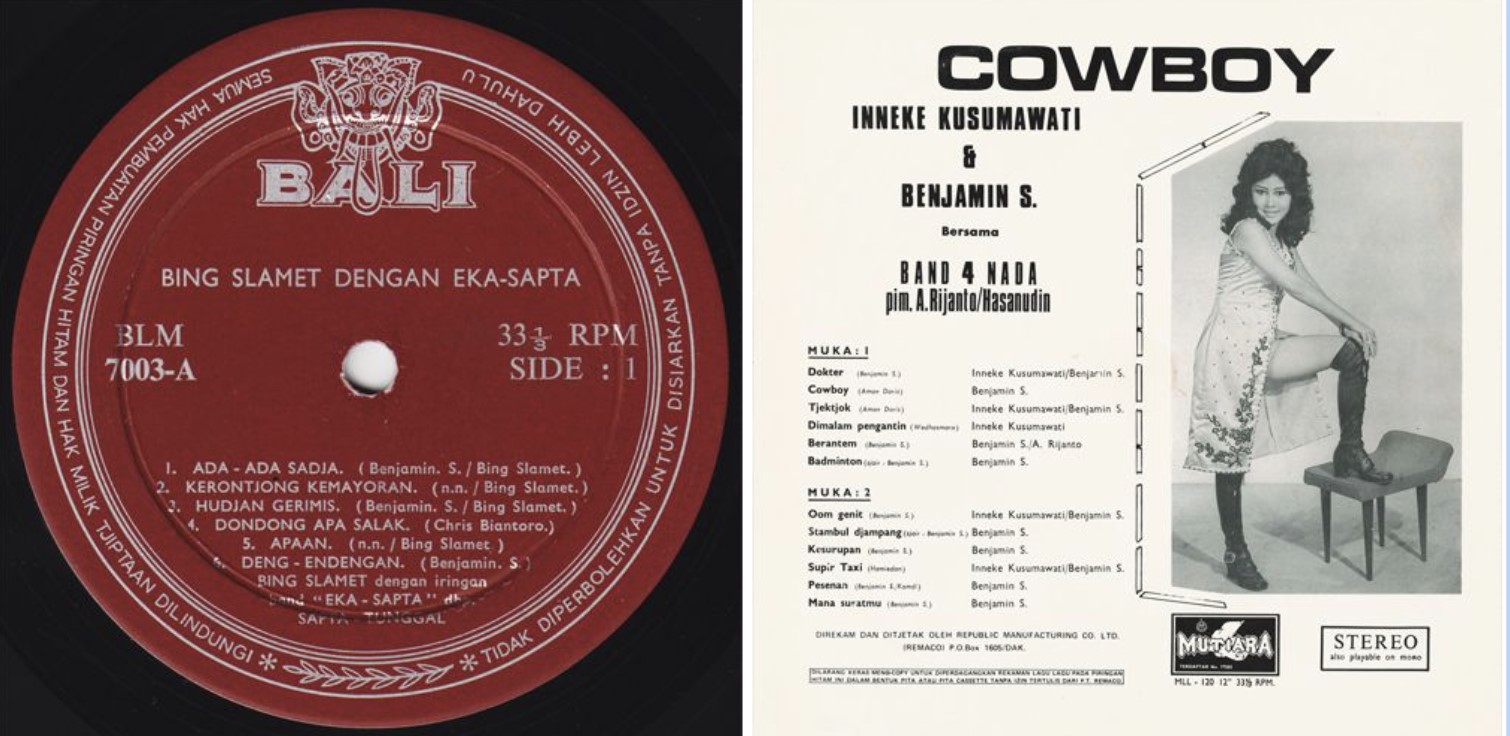
In 1968, Sueb composed the songs “Nonton Bioskop” (Watching a Movie at the Theater), “Hujan Gerimis” (Drizzle), “Endeng-Edndegan” and “Ada-Ada Saja” (It Is What It Is) for Indonesian singer/actor Bling Samet. All became big Indonesian hits. From 1968-1971, Sueb recorded and released no less than 50 albums, including the bestsellers Si Jampang (1969) and Ondel Ondel (1971). He also starred in 54 films, until 1976. He was honored by the Indonesian Film Festival, winning the Citra trophies for Best Main Actor in, Intan Berduri (1973) and Modern Doel Anak (1976). In 1977, he wrote a song for the Indonesian government named “Pungli,” which translates to “Extortion” in English, perhaps to help inspire positive citizenry and promote social order in Indonesia, which was suffering from corruption.

Sueb’s intersectionality growing up in poverty may have contributed to his prolific career. He often created his works from the standpoint of marginalized populations, his stories connecting and resonating with his fellow peoples due to “commoner” contexts. Sueb was propelled to superstar status in Indonesia by starring in films that focused on local archetypes: tukang (or “handymen”) in Tukang Solder and Tukang Becak; waria (or “transgender persons”); lovesick partners; bohemians; artisans; and eccentric horror movie characters. He formed a film company, Jiung Film, and produced works such as Musuh Bebuyutan (Arch-Nemesis; 1974), Benyamin Koboi Ngungsi (Benjamin the Refugee Cowboy; 1975) and Hippies Lokal (Local Hippies; 1976). He also starred in 11 films with his name in the title, like Benyamin Biang Kerok (1972), Benyamin Brengsek (Benyamin the Asshole; 1973) and Benyamin Jatuh Cinta (Benyamin Falls in Love; 1976) and others (Revolvy). 

In the 1980’s, Sueb starred in Betty Bencong Slebor (Betty the Frightful Transvestite), an important film that openly presents waria (transgender) and homosexual behavior in Indonesia. Unlike neighboring countries Singapore and Malaysia, which were influenced by British colonial rule, Indonesia did not criminalize homosexuality. Sueb’s character Betty challenged the moral ideals propagated by Suharto’s “New Order” beginning in 1966, to control the social order by limiting Westernism in Indonesia and promoting Muslim ideals based on gender ideology. Suharto’s rule, a.k.a. ibu-ism, promoted men as being “productive” beings and women as “reproductive” beings. Suharto promoted concepts of gender conformity. In order to be a “whole” person, Indonesians must conform to gender roles according to heteronormative family principles. Men are the head of the household, with woman as wife and raiser of children, all aligned in harmony with Islam. The government pushed heteronormative conformity through public campaigns that reinforced the expectations for women to reproduce and be obedient mothers/wives because this was their God given “destiny” (kodrat). Morally, homosexuality was seen as contradictory to God’s nature for Muslims in Indonesia, even though Indonesian indigenous language and culture acknowledged transgendered and homosexual behavior and allowed it to play a part in religious rituals (Munir, 2014).    

Photo courtesy of Kineforum

Betty Bencong Slebor stars Sueb playing a waria servant who serves the wealthy Bokir family, owners of a recording studio. In modern Indonesia, a waria is an indirect term derived from abbreviating wanita (woman) and pria (man), or “men with women souls.” LGBTQI+ Western binaries do not translate to Indonesian traditional societies, where ethnolocalized identities parallels links between professions with homosexual and trangendered behavior, e.g. gemblak-warok partnerships participating in the reog drama rituals in East Java, and male-to-female priests, or bissu, conducting religious rituals and rites in South Sulawesi neighborhoods. Betty is a jobless young man who becomes waria for employment much like ethnolocalized reog drama rituals of bissu, rather than becoming waria to conform to sexual/gender identity. Betty Bencong Slebor also challenges how social concepts in stereotyped gender binaries shape feminine and masculine traits that are attached to sexual identity. Betty dresses with make-up and wears her hair in a bun to appear attractive or “feminine.” She is a subservient maid who takes care of the family she serves. Betty also exudes toxic masculine traits by mocking a weak male pedicab driver because he cannot transport her up a hill in his pedicab. She sees him as weak and takes her aggression out on him by ridiculing him and throwing him into a field. Afterwards she squats in the field to pee, imitating women’s urinating behavior. Betty Bencong Slebor intelligently contrasts the fluidity of maleness and femaleness coexisting, although the concepts are not always fixed and mutually exclusive (Munir, 2014). Unfortunately Sueb closed his film company after he made Betty Bencong Slebor due to financial difficulties.

Before Sueb’s untimely death, he founded his radio station Ben’s Radio, on March 5, 1990. Ben’s Radio’s purpose is to spread awareness for Betawi culture by transmitting Betawi culture through dialogue and musical programming. The radio station, located at 106.2 MHz FM in Jakarta and streaming online, is currently operated by Sueb’s children. The Sun City Girls wrote a song called “Ben’s Radio,” released on their album Funeral Mariachi on Abduction in 2010. The song opens with samples in Betawi taken from Ben’s Radio transmissions. Sun City Girls’ fans know members Charles Gocher and Richard and Alan Bishop often synthesized ethnic musics from South Asia, Africa, the Middle East and South America with jazz, rock, prog and experimental music. It makes me happy to think Sueb’s music has influenced legendary cult bands like Sun City Girls.

On Sept 5, 1995, Benjamin Sueb passed away from a heart attack after playing soccer. He was 56 years old. He is survived by his nine children and his wife, all of whom continue his legacy in keeping the rich Betawi culture alive. Indonesia continues to celebrate Sueb through Ben’s Radio as well as an autobiographical musical, Babe, performed by the Jakartan theater troupe Teater Abnon, in 2017. There is also continuing speculation among Sueb’s children and the Indonesian government about converting their father’s residence into a museum commemorating Betawi culture and Sueb’s unique life, a life cut short too soon. 

Photo courtesy of merahputih

(Originally published on Freeform Portland’s Blog.)

References

Munir, Maimunah (2014), Challenging New Order’s Gender Ideology in Benyamin Sueb’s 

Betty Becong Slebor: A Queer Reading http://www.plarideljournal.org/article/challenging-new-orders-gender-ideology-in-benyamin-suebs-betty-bencong-slebor-a-queer-reading/

Revolvy/BenyaminSueb

Wikipdedia Benyamin Sueb 

https://ipfs.io/ipfs/QmXoypizjW3WknFiJnKLwHCnL72vedxjQkDDP1mXWo6uco/wiki/Benyamin_Sueb.html

Written by Karen Lee (Weekend Family Music Hour)

Nigerian Afrobeat: The Wings, Original Wings & Super Wings

FullSizeR(4)

(We are deeply indebted to original band member Manford Best Okaro for everything below. See his incredible book History of the Wings for additional information.)

In 1966, civil war erupted in Nigeria. Hostilities had been building since the bloody Kano riot of 1953, and the discovery of additional oil reserves in the east reignited the conflict. The Prime Minister and his cabinet were killed in a coup by Igbo secessionists who declared themselves the breakaway Republic of Biafra. “The perpetrators brazenly looted properties, raped women and committed unfathomable atrocities under the guise of a religious uprising,” Wings guitarist Manford Best recounts in his book, History of the Wings. “This exodus led to an influx of refugees and caused untold hardship such that hunger and starvation became the orders of the day.” Young men in Biafra were expected to fight for the survival of the new republic, but the safer gig was logistical support for the military. This included bands to perform at bases and official events, and to boost overall troop morale. Hence, the Biafran Air Force created a band called BAF Wings.

3b
Biafran Air Force, 1967.

BAF Wings consisted of two distinct units of musicians: a popular highlife section, led by established bandleader Adolf King; and a second smaller line-up geared towards the “beat” pop music of the day. This pop band consisted of Dream Lovell (Dan Ian) on lead guitar, Gab Zani on lead vocals, Jonathan “Spud Nathan” Udensi on rhythm guitar, Arinze “Ari” Okpala on bass, and Manford Best on drums, with Frank Moses Nwandu acting as manager. The military paid for instruments, amplifiers, and a bus for transportation between assignments. The two sections continued on until the collapse, as recounted by Manford Best:

“After Christmas 1969, it became clear that Biafra was about to lose the battle. When non-stop gunfire and mortar shells started landing everywhere indiscriminately, we knew that advancing Federal soldiers had finally broken through in several sectors. As people in general including the highlife section ran for their dear lives in different directions on foot, members of the pop music section decided to converge at Azia, which was Spud Nathan’s village. Despite the fact that there was no time for a thorough movement plan, we were able to salvage two amplifiers, three microphones, loud speakers, the drumset and two guitars as we fled. Thereafter, we went to our various villages to reunite with members of our families and for them to be aware that we survived the war.”

A ceasefire came in 1970. The country was devastated, especially the east, with civilian deaths a staggering 500,000 to 3,000,000, mainly from famine and disease caused by the blockade. Nigeria was temporarily divided into four states, and the renowned sounds created by the funk bands of the defeated Biafran independence movement quickly began to take hold and spread across the nation. The reformed band, now simply The Wings, decided to base themselves in Enugu, the new capital of eastern Nigeria, focusing on hotels as their mainstay. If you could get steady work at a hotel, you could become a sort of house band there, building a following and making enough to live on. Any spare income earned by the band was invested back into improved equipment (synthesizers and organs were notoriously hard to maintain), and through this process, they became regulars at the Dayspring Hotel on Sunday afternoons, playing primarily pop/soul numbers by The Beatles, James Brown, Sly and the Family Stone, and Otis Redding.

A significant setback occurred when lead guitarist Dan Ian (later of Wrinkar Experience) and singer Gab Zani (later of One World) decided to leave the band, which effectively ended their tenure at the hotel. Just as the band was on the verge of splitting, their manager was approached with a fortuitous offer of a 1-year contract with 33rd Brigade Headquarters in Maiduguri. This meant a monthly salary, free housing, health care, all new musical gear, plus a new bus. The members of the band agreed that it was a great opportunity, despite the lack of autonomy that went along with being a military attachment; at least there was no war. They quickly grabbed two new members to flesh out the lineup: Okechukwu “Okey” Uwakwe, a lanky guitarist from a band called The Wavelengths; and Pius Dellin, a keyboard player from neighboring Kano. The band’s existing rhythm guitarist Spud Nathan, who had already been singing some highlife numbers during the band’s hotel sets, mainly to give vocalist Gab Zani a break, stepped in to lead vocals and began honing his voice.

It was now 1971 and pop music was making inroads on the African highlife scene. Fela Kuti and his drummer Tony Allen, inspired in part by Sierra Leone’s funk stars Geraldo Pino & the Heartbeats, are credited with coining the term “Afrobeat” to describe this new sound. EMI’s Nigerian subsidiary began scouting local talent to sign, as did Decca. When not performing for military functions, The Wings were free to gig around the city of Aba at will, and they quickly became a fixture in the burgeoning club scene, primarily at the Ambassador and Unicoco hotels, where they played with house band The Funkees. This led to their being signed by EMI.

Youll-Want-Me-Back
“You’ll Want Me Back” 7″, 1972

In early 1972, the band headed to Lagos and recorded their first 7” single, entitled “You’ll Want Me Back” b/w “Catch That Love.” The release sold well and brought them nationwide radio exposure for the first time. This was followed within six months by “Afam Efuna” b/w “Had I Known” on the HMV label. At this point, due to increasing opportunities and regional fame, they opted not to renew their contract with the military, which resulted in a punitive confiscation of all gear and equipment which the military had purchased, including their bus. Once more, the band was destitute and on the verge of financial ruin.

Jake Sollo and The Funkees, looking to relocate to England, arranged for the sale of their instruments to The Wings through negotiations with EMI, the label of both bands. This enabled the recording of their third and most successful single to date, in October 1973: “Someone Else Will” b/w “I’ve Been Loving You.” Former member Dan Ian played guest rhythm guitar on the track while his two sisters, Callista and Meg Mbaezue, sang backing harmony over Spud’s vocal. The band’s popularity accelerated quickly, culminating in their appearance on the premier musical program on NTA, the Nigerian Television Authority.

69770
Kissing You So Hard, The Wings, EMI/Capitol, 1974

For reasons unclear but purportedly to strengthen the rhythm section, additional percussionists Emma Dabro and Dandy Aduba were hired. Manford Best moved from drums to rhythm guitar, replaced by veteran highlife drummer Joel Madubuike, who is credited only as “Noel” on the back jacket of their first LP. It was with this lineup that The Wings entered EMI Studios in Lagos in April 1974 to record their first and only full-length album, Kissing You So Hard, with Pal Akalonu producing. The album was a regional success and stands today as one of the finest Nigerian pop records of all time, starting with Spud Nathan’s anthem “Single Boy” and ending with Uwakwe’s prophetic and plodding groove “Gone With The Sun.” (Due to a manufacturing issue, several songs are reversed in the running order for all copies I’ve seen.)

The production sound is cavernously wonderful and strange, with bursts of guitar and organ moving up high in the mix, disappearing, then surging back, all held together by Ari Okpala’s flying bass lines; check out “Make Me Happy,” with its two distinct passages of Uwakwe’s fuzzed-out guitar and Dellin’s organ breaks, punctuated with Madubuike’s precision drum fills. On the technical aspects of the recording process, Manford Best states that “while all the instruments were being played with the singing going on, the engineer skillfully recorded all the inputs at a go.” The album’s philosophical centerpiece is Spud Nathan’s cut “But Why,” in which he bleakly describes his “struggle to exist” when “emptiness drowns his whole life.” The song’s brooding spirituality would obsess fans for years, especially in light of what was shortly to come.

FullSizeR(3)
(L-R: Dandy Aduba, Spud Nathan, Pius Dellin, Okey Uwakwe, Manford Best; photo, M.Best)

December 26, 1974. The band played a gig at Mbaukwu. Stories differ as to what went down from this point forward with regard to a disagreement that night within the band. According to Best’s recent account, it was an established practice to rotate a leader monthly between the band’s core four members (Spud, Manford, Ari, and Okey). Spud was supposed to hand over leadership to Manford on December 24th, but he refused to do so for reasons unclear; the latter theorizes it was because a lucrative show was coming up in Port-Harcourt, and Spud wanted to be the one to collect and distribute the money. Tempers flared but Spud ultimately agreed to hand over control to Manford and rode with him in his newly-purchased Toyota to the next gig as a conciliatory gesture. At 4:00am, the band departed in separate vehicles to the town of their next show. Spud and Okey rode in Manford’s car and slept. What happened, according to Manford, is as follows:

“At about 6:00am, two kilometers after crossing the notorious Njaba bridge, we reached Azara-Obiato village and I was turning a corner when suddenly I saw a woman crossing the road. I tried to avoid her by swerving to the left but on seeing an oncoming vehicle swerved back to the right, lost control of the car and knocked her down in the process. The car skidded over the embankment and somersaulted in the bush resting finally on its side. The noisy impact of the crashing car and the alarming cries of the injured woman attracted villagers to the scene. They turned over the car to its normal position, forced the door open and carried Okey and I out while others rescued the woman. When I regained consciousness I stood up and heard Okey moaning and saying some indistinguishable words. I tried to help him stand up but he could not. This was because of the excruciating pain resulting from his injuries. I looked around and could not find Spud so I started shouting.”

FullSizeR(5)
Manford Best’s Toyota

Spud Nathan had been thrown from the car’s window; his neck snapped. Okey, writhing in pain and unable to stand, was placed on a bus and transported to two different hospitals, since the first lacked the expertise to handle the traumatic damage done to his spinal cord. The rest of the band, traveling in a different vehicle, would not learn of the crash until the following day. Word traveled fast throughout the region about the wreck and the circumstances behind it, feeding rumors and conjecture among fans and friends. Internally, between the bad blood from the fight beforehand, Best’s comparatively superficial injuries, and the mysterious unidentified “woman on the bridge,” suspicions arose immediately. Existing rifts between Best and the other founding members, especially Ari Okpala, erupted. According to Best, an assassination attempt was made on his life shortly after the crash, which he attributes to either Okpala or Spud Nathan’s sister in London. Ari Okpala and the other members decided to dissolve the band for two years in honor of their dead friend.

True to their plan, in 1976, Ari Okpala founded a new outfit called Original Wings International. Of the Kissing You So Hard lineup, only Okpala on bass and the hired percussionists, Dandy Aduba and Emma Dabro, remained. Johnny Fleming, who had briefly toured with an earlier pre-1974 iteration of the band, returned to replace Pius Dellin on keyboards. With Okey Uwakwe now paralyzed, Charles Effi Duke took over on lead guitar while Jerry Demua was hired to replace Spud Nathan on lead vocals. Drummer Joel Madubuike, who had already split to join the popular funk band The Apostles, was replaced by Emma Chinaka, a.k.a. Emma China.

R-3627395-1337952286-1179.jpeg-1
Men of the People, Super Wings, Clover Sound, 1976

Meanwhile, keyboardist Pius Dellin (also excluded from the Original Wings relaunch) alerted Manford Best of the brewing betrayal by their old comrades. Furious and feeling slighted, he immediately formed a rival band called Super Wings, with Pius on keys and four other musicians: John-John Duke on bass; Johnson Hart on drums; and George Black and Jerry Boifraind on vocals/percussion. Afraid of getting beaten to the punch and wanting to stake their claim to the name, they rushed into the studio to record a new album, signing to Lagos-based label Clover Sound, run by Ben Okonkwo. The resulting LP called Men of the People was, by Manford Best’s own account, a bit of a mess in the mix department, despite some ace performances, particularly the tracks “Lonely World,” “Trust Your Woman,” and Dellin’s shimmering “Sunshine of Tomorrow.”

tribute
Tribute to Spud Nathan, Original Wings, EMI, 1976

Although Men of the People is revered today as a classic, back then, this mad dash to the marketplace backfired. Sales of the LP were flat, and their second-rate status was soon sealed, when, just weeks later in 1976, Ari Okpala’s Original Wings released their own album, entitled Tribute To Spud Nathan, on Nigeria EMI, its cover sporting a photo of Spud, arms outstretched and in belled sleeves, singing onstage at a University of Nigeria show. Starting off with the tribute song “Spud Nathan,” which acknowledged the acrimonious splintering and promised peace from this point forward, it is a meticulously crafted record from start to finish, every bit as good as its forerunner Kissing You So Hard. Inspired rhythmic standouts include “Tell Me,” “Don’t Call Me A Fool,” and “Love Is Meant For Two.” It was, by all accounts of the time, a major comeback in the Nigerian pop scene.

R-5054206-1476475053-8052.jpeg
My Love Is For You, Super Wings, Clover Sound, 1977

Super Wings would persevere for one more record, again on Clover and with Ben Okonkwo producing. Most of the lineup remained, sans Jerry Boifraind, who left to record his first two solo LPs for Anodisc and Love Day. Lessons were clearly learned from the rushed release of Men of the People, and 1977’s My Love Is For You is the band’s creative apex. Manford Best’s crisp, reverb-drenched riffs, mixed with Pius Dellin’s organ and new vocalist Allwell Opara’s radical warbly vibrato, make for a distinctive and powerful unifying sound throughout its nine tracks, including “My Own People,” “Papa Was So Good,” and “Something (Love)’s Missing.” In true competitive form, that same year also saw the release of the Original Wings LP You’ll Want Me Back, which featured a re-worked version of the first 7” release by The Wings. While a fantastic record (“Stoop To Conquer,” “Help Yourself” and “Anonymous Man” are high-energy standouts), the balance between Original Wings and Super Wings was now shifting a bit.

change
Change This World, Original Wings, EMI, 1979

But it didn’t matter. The market was changing. Nigerian Disco and the spinoff scene later codified as Boogie were on the ascent. Funk bands across the country began closing up shop, with some musicians shifting increasingly into arrangement and production work. Manford Best shut down Super Wings and recorded two renowned solo albums. Original Wings released the superb Change This World in 1979 before Ari Okpala decided to dissolve this iteration of the band permanently. Johnny Fleming would use the name Original Wings In London for his excellent solo album Forgive Me from 1981, and some members (or at least Dandy Aduba on rhythm guitar) would return as backing band Wings International on Okpala’s synth jammer record Better Love, released on EMI Nigeria in 1985. It is the last release of his that I know of.

Founding lead guitarist Okey Uwakwe’s eventual death in 1977, from spinal injuries sustained in the car crash years earlier, was the sad closing coda for both outfits. Today, “The Wings of Aba” and the name of Spud Nathan are legendary in Nigeria.

By the Law

po_zakonu_banner

“The theme of the picture By The Law is alien to our viewer in script and essence. Considering the instances of pathology and hysteria [in the film], it is a sick phenomenon in our cinematography which harmfully affects our Soviet screen.” — A.R.K. (Association of Revolutionary Cinematography), 1926.

“We may be accused of being morbid or misanthropic, but please do not forget that our film is about the modern English middle class–surely the most inhuman of all.” — Lev Kuleshov, 1926.

duralex3f

It feels weird when a 92-year-old Soviet film can say so much about the contemporary world. Class violence, retribution, environmental chaos–all are active ingredients in Lev Kuleshov’s “constructivist Western” By The Law (Po Zakonu). Viewing it today, from the Great Acceleration period of the Anthropocene, is like peeking into a creepy apocalyptic window of past and future. Like Marx, the Soviets believed that capitalism would destroy humanity; and lo and behold, here we are, on the way to our own Easter-Island party, with investors buying up escape-pod properties in New Zealand to ensure that this model survives for their entrepreneurial offspring, who will presumably sell shares in the Norwegian Seed Vault.  /communist_rant

The coming of Russian film coincided with the creation of the U.S.S.R., the world’s first modern worker state. It provided the opportunity for a clean break from the literature and drama of the 19th-century, both of which the Soviet intellectuals rejected as bourgeois tools of domination controlled by the aristocracy. With 80% of the Russian population illiterate, it was believed that this new visual medium would usher in a transformative era of avant-garde modernity, offering a conduit through which the nascent nation could educate and galvanize the people. Like rail lines and power grids, film would connect the disparate corners of the Soviet together. It would create social cohesion between ethnic groups and help authorities overcome the huge communication hurdles of time and space.

But things got weird. The period of genuine openness and experimentation was over fast and in steep decline after Lenin’s death. Anything avant-garde suddenly became elite, epicurean and subject to suspicion. Film plots were required to be both entertaining (without being “too American”) and reflect deeper socialist worldviews, a concept called Socialist Realism. Many in the industry, particularly directors, screenwriters, and cinematographers, struggled between these two worlds. Their continued employment and access to funding meant keeping the cultural commissars satisfied with works that met this criteria. As if it wasn’t hard enough making wheat quota subplots stimulating, the films should also be exportable abroad and appeal to international audiences.

004
Kuleshov Collective practicing on a rooftop

It was within this confused climate that the Kuleshov Collective, a close-knit group of actors and technicians started by director Lev Kuleshov, set to work on a new project in 1926. (Kuleshov pioneered several techniques of early film montage theory that today would be taken for granted; one is called the Kuleshov Effect, which asserted that one shot placed beside a second can alter a human’s emotional interpretation.) The Collective’s biggest success thus far had been in 1924, with the brilliant satirical comedy The Adventures of Mr. West in the Land of the Bolsheviks, which lampooned both American and Soviet stereotypes equally. But the group was now on shaky ground after its disastrous follow-up, when a long and confusing sci-fi film called The Death Ray was thoroughly hated by everyone. Kuleshov knew that the collective’s next project had to come in on the cheap and be a hit. While it would have been easy to fall back on the safety of West’s comedic formula, he happened across a gloomy story by American socialist writer Jack London called “The Unexpected” and decided to adapt it with screenwriter Victor Shklovsky. Finishing the script in 12 hours, they started scouting locations outside Moscow that could serve as the Yukon. They spotted the “huge and forlorn” pine tree first, near the Tsaritsino ponds. Then the Collective built a small shack on the banks of the icy Moskva River. The majority of the film would be just three actors inside this claustrophobic interior. It would be the cheapest Russian production of all time.

Ultimately, it’s the performances of Aleksandra Khokhlova (as Edith) and Vladimir Fogel (as Dennin) that make By The Law so exceptional. Aleksandra Khokhlova was Kuleshov’s spouse and creative partner. Like the others in the Collective, she had starred in most of his previous films; but unlike the men, she was mercilessly mocked and insulted by critics for her angular looks and skinniness. Lev Kuleshov hit back, saying “The commercial pursuit of beauties and names is none other than hidden pornography or psycho-pathology for which there is absolutely no place in Soviet cinematography.” The best English write-up of the film belongs to American poet Hilda Doolittle, better known as “H.D.”, in the 1928 issue of the film journal Close-Up. Watching the German version Söhne in a Switzerland theater, she described Khokhlova’s performance (taken from Ana Olenina’s incredible Khokhlova bio at the Women Film Pioneers Project):

The gestures of this woman are angular, bird-like, claw-like, skeleton-like and hideous. She has a way of standing against a sky line that makes a hieroglyph, that spells almost visibly some message of cryptic symbolism. Her gestures are magnificent. If this is Russian, then I am Russian. Beauty is too facile a word to describe this; this woman is a sort of bleak young sorceress…Her face can be termed beautiful in the same way that dawn can be termed beautiful rising across stench and fever of battle…This sort of raw picked beauty must of necessity destroy the wax and candy-box “realism” of the so much so-called film art. It must destroy in fact so much that perhaps it does “go”, as one of our party said, “too far”.

This notion of “too far”-ness echoes a similar comment made by Cinema Front critic Viktor Pertsov, as noted by scholar Denise Youngblood in her Soviet Cinema in the Silent Era 1918-1935, the authoritative Western text on this subject. Youngblood says Pertsov criticized Kuleshov for not guiding the viewer to moral judgment or providing a social key with which to decode the film, which he described as “hermetically sealed.” While meant negatively, today this hermetic sealing is precisely what makes this movie so radically accessible to new viewers. Unlike other Russian films from the period, it ties itself to no historical event or revolutionary act but merely works its way through its own myopic microcosm of greed and madness, close-up by close-up, breakdown by breakdown.

duralex5
Aleksandra Khokhlova’s “hieroglyph”

Kuleshov was known for making dangerous physical demands on his actors, although the confined interior of By The Law theoretically made for safer working conditions. The shoot was carefully timed to overlap with a spring thaw and flood event. Actors would freeze, be submerged, and have off-screen airplane propellers blow snow and sleet into their faces. Kuleshov described the expereince in Fifty Years In Films:

Spring came, the ice on the river broke. We went on shooting, but suddenly it became apparent that we were having quite an unusual flood: the river water was inundating the cabin, its level steadily rising. The wet cables produced electric shocks whenever one inadvertently touched them, but Khokhlova affirmed that “electricity made her feel more intensely”. While a close shot was being made, Fogel lay bound on ice in the fire-hose rain and airplane wind for two and a half hours. (p.228-229)

Vladimir Fogel was better known for his comedic roles in hit films like Chess Fever, where his neurotic performance shows his gift for physical comedy. But today, it is his portrayal of the exploited and embittered Irishman in By The Law that stands as his highest achievement. Kuleshov wanted extreme states of being from the faces of his actors. This is why the Collective practiced incessantly using still photographs and études, trying to move beyond the cliched facial expressions so common to the stage. Truly extreme states of being, they believed, could never be attained through psychological immersion. In that sense, they rejected theater theorist Stanislavski’s approach as a mere dressing-up of canned Victorian melodrama. Actors were mechanical beings subject to the laws of science. Ana Olenina summarizes this well in her article “Engineering Performance: Lev Kuleshov, Soviet Reflexology, and Labor Efficiency Studies”:

Kuleshov’s explorations were driven by his conviction that the performer must exploit the abilities of his or her body to the maximum extent and create corporeal spectacles that would strike the audience with their unusualness, dynamism, and perfection in every detail. Thus, the acting études and films created by Kuleshov’s troupe in the 1920s were marked by a clear tendency on the one hand, toward tragicomic grotesque and buffoonery, and on the other hand, toward extreme physical performances (p.300).

Although the end product was criticized for its “Americanism,” it was a big enough hit to prove the end of the Kuleshov Collective, as Fogel and others departed for the stable paychecks offered by the larger Soviet film factories. Fogel would soon play the proletariat couchsurfing homewrecker in Bed & Sofa, followed by The House on Trubnaya. Tragically, he killed himself in 1929, although likely not for the reasons stated by Kuleshov in his memoirs (because of “uninteresting work”). On the other hand, his suicide did coincide with the coming of sound film, a difficult time for all actors but especially international ones. Aleksandra Khokhlova, failing to meet Soviet beauty standards, could only get work in Kuleshov projects. Soon, she would turn to directing films herself, including an adaptation of Maxim Gorky’s An Affair of the Clasps (1929), Sasha (1930), and a documentary called Toys (1931).

In closing, the score of this particular DVD restoration deserves mention. The majority of silent films have no remaining soundtrack notes with regard to what should be played during a screening. This is true for By The Law. Most restorations go the safe route and commission a solo piano score, or something orchestral from the time period that fits. Luckily, the Austrian Film Museum decided something different was needed and went with electronic composer Franz Reisecker, who had previously worked on a score for Eisenstein’s Battleship Potemkin restoration. His dissonant and fractured tones work brilliantly alongside Kuleshov’s images. “I was fascinated with actress Aleksandra Khokhlova, because of her very particular expressive style, and then with the montage and Kuleshov’s highly artificial visual language,” Reisecker said in an interview. “It reminded me of Spaghetti Westerns. I went back to Ennio Morricone’s music for Sergio Leone’s films and developed some sounds based on the bell motif. Then there is a sequence that almost has the character of a dance track when they find gold…and despite the groove there is a hint of threat in the sound.”

002
Cast/Crew shot from set of By The Law; Khokhlova in scarf, Fogel in glasses, Kuleshov center left.

SOURCES:

Kuleshov, L. V. (Lev Vladimirovich), et al. Fifty Years in Films : Selected Works. Raduga Publishers, 1987.

Youngblood, Denise J. (Denise Jeanne). Soviet Cinema in the Silent Era, 1918-1935. 1st University of Texas Press ed., University of Texas Press, 1991.

Women Film Pioneers Project. (https://wfpp.columbia.edu/)

Drugstore Cowboy: Workprint

drugstore

“It wasn’t me, pal, I ain’t hit no poison shops in years!” – Matt Dillon as Bob, Drugstore Cowboy: Workprint

No film ever shot in Portland has come to personify the city like Gus Van Sant’s 1989 breakthrough feature Drugstore Cowboy. In fact, it holds such a place of prominence that the impatient are already gearing up this month to celebrate its 30th anniversary based on production instead of release date, with screenings, walking tours of locations, etc. The only local screenings scheduled so far are for the normal 101-minute version. Van Sant seems to have little interest in re-visiting other cuts of the film, which is understandable. Editors exist for a reason. Anyone who has ever had to sit through an awful “restored” director’s cut understands this. Most works are harmed more than they are helped. In interviews, the sole editorial point of conflict mentioned by Van Sant was his unwillingness to cut William S. Burroughs from the film, as requested by the studio. There were also several moments in his commentary for the 1999 DVD release, done with Matt Dillon, in which he questioned the necessity of a few edits or changes to the shooting script. But overall, he sounded content with his first big-budget Hollywood experience and did not come across as having compromised his ideas for the sake of money.

While the original is wonderful, an alternate videocassette version exists. It was likely a “workprint” VHS transfer of an early proposed cut, intended for editing. Or maybe it was a rejected alternate version submitted to the studio for review. Whatever its function, it adds around 20 minutes to the film’s running time, while also eliminating or using alternate takes for some scenes that were included in the final Avenue Pictures release. The Workprint feels a lot more like Mala Noche–Van Sant’s previous feature, also shot in Portland–and makes for a way grittier experience than Hollywood’s version, with no special effects, no jazz score, no drug paraphernalia optics, no credits. Appropriately, the grainy print takes on the aesthetic characteristics of a darkly funny 16mm afterschool TV parable about the black hole of addiction.

Before I get into specific differences, a bit of background on the source material. James Fogle was an infamous Pacific-Northwest drug addict and pharmacy thief, and the shooting script was based on an unpublished manuscript of his, which was picked up by Delta only after the film’s success, in 1990. The book is loaded with dialogue, with some passages ridiculously long, stilted, and unnatural sounding. Van Sant and Dillon, in the original DVD commentary, discuss the copious amounts of colorful text written by Fogle and the attempts at condensing that into script form, while retaining some of his key phrases, like “poison shops,” “dope fiends,” and “T.V. babies.” I did a quick scan, and all of the removed major scenes–and most of the dialogue therein–are present in Fogle’s novel. With the Workprint just passing the 2-hour mark, in an era when films were rarely over 90 minutes, the cutting of entire sequences was likely to tighten the pace. The same can’t be said for the inclusion of alternate takes and the differences in tone created by those. It seems that at some stage in the editing process, Drugstore Cowboy began to drift from Van Sant’s darkly comedic leanings. These nuances can be subtle and hard to spot; for example, a line delivered by Matt Dillon in Workprint will be hilariously paranoid, while the Avenue cut would utilize an alternate take of the same scene, but with Dillon conveying anger or hostility. Overall, there is an increased 1st-person viewpoint for the Avenue cut, while the Workprint includes more scenes for which Bob’s character would not be present, such as conversations between pharmacists and supporting characters.

Second, there’s the music. Since the videotape lacks credits, for years I struggled to find out what the songs were, and there is still one Hawaiian slack-key guitar piece that I can’t figure out. It’s unclear why some of the Workprint songs were removed from the Avenue cut; probably licensing issues, or maybe they were always intended as placeholders for Elliot Goldenthal’s dissonant jazz cues, which comprised half of the original soundtrack. One sequence in particular deserves mention. It occurs halfway through the police’s duplex raid, as Detective Gentry and the cops hunt for the hidden dope stash. Instead of Bob answering Gentry’s question “What’s it gonna be?”–as in, “Will you give us the drugs or will we trash your place?”–there is a pause. Instead of an answer, Elis Regina’s voice drops in from nowhere with the opening line of “Águas de Março,” and her duet with Jobim then continues over a montage of furniture demolition, the knifing of sofas, the emptying of cereal boxes; there is a brief exterior shot of the shadows of axes coming down in the duplex windows, then a slow pan up a landscape of leftover debris: Coca-Cola bottles, Fidel Castro’s photo, furniture legs, insulation. In the Avenue cut, there is just a fade to black after Gentry’s question and a truncated debris shot, without music, ending with the cast sitting covered in blankets for reasons that are vague (since the preceding scene of cops shredding their clothing was removed.) Approaches like this epitomize the differences between the two versions. Maybe it was Hollywood, with one eye on the editing clock. Just as they wanted Burroughs removed, perhaps they trimmed all bits tangential to the storyline. But the “Águas de Março” sequence in Workprint is really exceptional and the film lacks without it. Desmond Dekker’s “Israelites” is still present but less prominent, being used as source music in the apartment’s interior, not an incidental cue.

Apart from music, there are several great added sequences from the novel. Diane’s sister comes by to bring clothes and belittle Bob, which explains their ill-fitting clothes in the Avenue cut. In two other missing scenes, Diane attempts to score drugs from a doctor, and Diane and Rick talk out a plan to continue stealing following Bob’s departure to rehab. Of the alternate takes, the one at the rehab clinic when Bob is being asked questions by the social worker (brilliantly played by Beah Richards) is altogether different, with a slow French New Wave-ish back-and-forth pan as he answers her questions. Another vastly improved sequence is when Nadine asks if the crew can get a dog, thus starting the hex spiral. Canned dramatic music is inserted here. “It’s over. We ain’t going to the coast. We ain’t going anywhere!” Bob mutters behind horns, strings, and crashing percussion that sounds like it’s ripped from a 70s TV crime procedural. It’s clear that many funny elements did not survive. Odd lines from the novel that are admiringly goofy in Workprint (“Hot dawg!” is a keeper) are gone from the final cut. It seems that at some point in the editing, the decision was made to emphasize Bob’s patriarchal toughness and redemption at the expense of junky weirdness and paranoid melodrama.

This shaky redemption is conveyed through the bookending device that begins and ends the original film. From the outset, in the ambulance, we hear Bob’s half-dead, mellowed-out opinions about everyone on his crew as we watch their home-movies running through his brain. We are not allowed to be introduced to the characters through their actions. We must first hear Bob’s impressions of them and how he has come to define their identities, assigning him an omnipotent God-like quality from the beginning. Conversely, the linear Workprint cut starts in a more egalitarian manner, loud and fast with aerial car shots of the crew en route to the “epilepsy routine”, using an anachronistic Skinny Puppy song that is very far in tone from Abbey Lincoln’s “For All We Know.” It ends cold-stop, in the ambulance, with the head-shot of Dillon said to be modeled on Warhol’s short film Blowjob. Unlike with the Avenue cut, there’s no rehash of the home-movie at the film’s credits, over a replay of “Israelites”, a sequence which always felt to me like a tired Hollywood trope, the equivalent of a blooper reel designed to uplift any audience members who may have become depressed after hours of addicts. Interestingly, according to Dillon and Van Sant, the handheld home-movie sequence was shot by the cast post-production and was designed to be used for promotional purposes. (A photo from that day, taken against the famous Lovejoy columns painted by Tom Stefopoulos, became the main image on the one-sheet poster) Which begs the question: if this was done post-production and intended for advertising, why was it edited into the final film? In Workprint, there is no nostalgia, no redemption, no resolution. The end is abrupt and arbitrary. In the book, Bob is dead-on-arrival. The TV Babies win. The hat hex is complete.

NOTE: DC:Workprint is not available in Watzek’s circulating collection. The screening is free and restricted to Lewis & Clark College community.

The Wonderful World of Electronic Voice Phenomena

Electronic Voice Phenomena (EVP) are sounds or voices that are transmitted through electronic sources. They can be recorded and heard during or after playback from recordings on analog or digital machines. People who believe in the paranormal often postulate EVP are voices from deceased people, demons, aliens or beings from an unknown dimension who are trying to communicate with the living. These sounds or voices are often interpreted as radio or other media transmitted interference that have been recorded at lower frequencies, where hearing these sounds/voices in real time is often inaudible during the recording. EVP recordings often appeal to fans of experimental, electronic, or noise music genres, sometimes combining instrumental melodies and layers of white noise. EVP frequencies may also be strengthened by short wave radio or digital signals, where para-psychics are able to “tune in” to capturing and conversing with these phenomena.     

The first spirit voice was recorded on tape by Reverend Drayton Thomas while working with Gladys Osborne, a famous medium who channeled Thomas’ deceased father during a seance in the 1940s. Psychologist Raymond Bayless and psychic Attila von Szalay researched the recording of EVP from hearing voices around them. Attempts were made to record these voices with a 78 RPM Pack Bell Record Player and Cutter but to no avail. Bayless and Sazalay eventually constructed an EVP recorder consisting of a microphone inside of a cabinet resting inside a speaking trumpet. A cord connected to the microphone led to a tape recorder outside of the cabinet, which was connected to a loudspeaker. They heard whispers from inside the cabinet upon connection and recorded the occurrence. Szalay continued to capture EVP recordings on reel to reel tape, and Bayless and Szalay published an EVP article in 1956, in the Journal of the American Society for Psychical Research (Poysden, 1999). 

A notable EVP early researcher was a retired Swedish opera singer, bird watcher and film producer by the name of Friedrich Jurgenson. After recording bird calls in a field near his home, when he played the recording back, he noticed voices on the tape. He believed one of the voices was his dead mother calling his name, while other voices spoke in different languages, sometimes changing vernacular in the middle of a sentence. There were often grammatical errors or words uttered with elongated syllables, and some voices even seemed to respond to his questions while he was listening and talking back to the tape. He began transcribing his conversations and, after four years of research, authored a book published in 1963 in Stockholm, Roesterna Fraen Rymden (Voices From the Universe). Jurgenson hypothesized the tape recorder was acting as a CB (citizens’ band) radio in communicating with the dead (Poysden, 1999).

Friedrich Jurgenson

Jurgenson influenced Latvian psychologist Dr. Konstantin Raudive after he read Jurgenson’s book in 1964. He was so intrigued by Roesterna Fraen Rymden (Voices From the Universe) that he contacted him in 1965 to further research EVP. After numerous recordings, upon playback they detected faint voices in Latvian, French and German, one of the voices belonging to a French woman known to Raudive, Margarete Petrautzki, who had recently passed away from illness. Raudive transcribed the recorded voice, saying “Va dormir Margarete” (“Go to sleep Margarete”). Raudive spent a large part of his life studying and researching EVP. He came up with several techniques in channeling, recording, and contacting spirits using various electronic devices. He recorded over 70,000 audiotapes in his laboratory and collaborated with Hans Bender, a German parapsychologist, as well as 400 others who had heard the voices Raudive had recorded and communicated with in his 1971 book, Breakthrough. Raudive listed three methods in capturing EVP, including: 

Konstantin Raudive – Breakthrough (Full Recording)

  1. Microphone voices; pressing the record button on a tape recorder with a microphone in an empty room or place; the tape recorder sometimes does not have to be turned on. 
  2. Radio voices; recording white noise from the radio without being tuned to a station. 
  3. Diode voices; recording homemade simple radio receivers powered by two terminal electronic components not tuned to a station.  
Konstantine Raudive (Pic: TCI Argentina)

Raudive describes the characteristics of voices one may hear, including entities speaking in rapid mixtures of languages or in different rhythms that appear to be forced, some similar to short telegram messages or neologisms (Antiworld.se, 2008). He claims voices on the diode method were audibly stronger when more white noise was present. Many critics presumed EVP were samples of normal radio transmissions coming in from differing radio frequencies but critics could not explain why the voices were able to mutter Raudive’s name recurrently. Many spirit voices also had a sense of humor, appearing to become bored, tease, or converse about the weather. On the Vista label, Raudive released a 7” record with his expanded version of Breakthrough: an Amazing Experiment in Electronic Communication with the Dead, published in England by Colin Smythe Ltd. in 1971. It included spirit messages from Ortega Y Gasset and Russian poet Vladimir Mayakovsky. 

In the U.S., Thomas Edison was a believer of EVP, and he discussed how to record spirit voices in 1928, later attempting to utilize modified television sets, tuning them to 740 megahertz to enable paranormal effects (Poysden, 1999). In Europe, EVP became popular in the 1960s and 1970s, where many amatuer para psychics dabbled with homemade tape recorders. In the late 1970s, Americans Paul Jones, G.W Meek and Hans Heckman started a lab researching two way voice communication using more advanced equipment. George and Jeannette Meek met psychic William O’Neil, who was “electronically literate” and could hear and see ghosts. The Meeks funded and directed research into spirit communication while O’Neil operated electronic methodologies and used his psychic expertise. O’Neil was able to communicate with a deceased colleague, Dr. Jefferies Mueller, who was a professor and NASA scientist who materialized in O’Neil’s living room to announce he was going to help construct new electromagnetic equipment to convert spirit voices into audible voices. The device was named Spiricom, with a set of tone and frequency generators that relayed 13 male tones extending all ranges of the adult male voice (Afterlife, 2014).

The Meeks founded a non profit organization, Metascience Foundation, in the 1970s to interpret dimensions that separate the living and the deceased and the many levels of planes between, which they described as interpenetrating or interwoven worlds or spaces. The Metascience Foundation objectives were to  provide a scientific basis for knowing:

  • That life is eternal
  • That each person is a son or daughter of God, the Father, the Universal Mind or the Creator of all that exists
  • That the life of each person is of infinite importance and has specific purpose and ultimate meaning
  • That limitless love of neighbor and self leads to inner peace, happiness and good health

The Meeks believed these levels of understanding can be achieved through direct contact with “accumulated wisdom of the ages, currently available on the Mental and Causal Planes. It is our conviction that the most reliable access to this information can be perfecting a dependable two-way electromagnetic-etheric communication system” (itcvoices.org, 2016). 

George and Jeanette Meek

The Astral Planes According to George Meek

George Meek believed that mystic and spiritual worlds throughout the centuries had failed to explain the vastness of the universe, or parallel universes that have interpenetrated our physical universe. Meek found it odd that Spiritual folk always explained that the path to a higher god/deity lies within. He used electromagnetic fields and technologies to better understand the living plane from people who no longer needed their living bodies through EVP. “All the spiritual universes–and there are hundreds of them–they’re all sharing this physical space with our physical universe, like radio signals sharing this room” (Meek, 1991). To Meek, all universes are “broadcast” from a central source, naming deities like God, Allah, Buddha or Brahman. These universes are set up by deities and energy from deceased people, which are  finer energies than electricity, radio or light. These spirit energies cannot be accessed by living physical senses or modern scientific approaches, which is why he co-created the Spiricom with O’Neil (worlditc.org).

Among those attracted to these new theories of EVP was early electronic music pioneer and gay icon Joe Meek (no relation to George or Jeanette Meek), whose sonically strange recordings, the most famous being The Tornados’ “Telstar,” revolutionized experimental outsider pop in the 1960s. Meek mic’d toilets, played with pitch, and generally approached his work in the kitchen-sink fashion of BBC’s Radiophonic Workshop (one can only dream of a collaboration between Delia Derbyshire and Joe Meek). A firm believer in all things paranormal and occult, Meek conducted EVP recordings in his London studio because it was located on a busy street with lots of white noise. He also started recording in cemeteries, convinced that he was communicating with his idol, the late Buddy Holly. Meek’s 1961 song, “Tribute to Buddy Holly,” performed by Mike Berry and the Outlaws, may have been co-written with “Buddy” in Meek’s London studio. Like many of his productions, the structure of the song is strange, going on for an entire extra verse and additional minute after the bridge break and 2:00 mark, when most 45s would be fading out. This length gives it a trace-like quality. In the ultimate coincidence, Meek’s final psychic break, in which he notoriously murdered his landlady during a noise complaint before committing suicide, happened to occur on the day of Buddy Holly’s death, February 3rd. 

Joe Meek, in his U.K. studio

The most infamous EVP recording, The Ghost Orchid: A Introduction to EVP, was released by PARC (Parapsychic Acoustic Research Cooperative) and Ash International, in 1999. Filed under “Electronic,” this was the first ever comprehensive investigation into EVP ever to be released. Listeners are guided through a collection of music, voices and sounds that were recorded on tape, with a 12-page booklet accompanied by articles with criticisms, explanations and hypotheses surrounding the phenomena. The CD has commentary from Swedish artist Leif Elggren, England’s leading EVP researcher Raymond Cass, and one of the field’s early pioneers, Dr. Konstantin Raudive. This recording solicits listeners into questioning EVP evidence to help us examine our own perceptions or preconceptions about human existence and spiritual belief systems. Perhaps EVP are the answers we seek to validate our own existential crises. Or perhaps we hear what we need or want to hear, constructing a “meaningful” white noise world from nothingness.

Written by Karen Lee, edits by Jim Bunnelle

References:

Antiworld.se http://www.antiworld.se/project/background/evp.html

Electronic Voice Phenomena UK http://www.electronicvoicephenomena.co.uk/joe-meek-evp

Institute for Afterlife Research http://www.mikepettigrew.com/afterlife/html/evp___itc_history.html

Meek’s Interpenetrating Worlds of Life and Consciousness http://itcvoices.org/meeks-interpenetrating-worlds-life-consciousness/

Poysden, Mark : This is EVP: A Look Behind “The Ghost Orchid” CD https://www.anomalist.com/features/evp.html

World ITC.org http://www.worlditc.org/h_07_meek_by_macy.htm