

On March 10, 1925, Otto Rothstock, a 25-year old dental technician, entered the publishing offices of writer and social activist Hugo Bettauer. As a curious Bettauer watched on, Rothstock calmly locked the door behind him, turned to face the desk, and fired a revolver five times into Bettauer’s chest at point-blank range. Such was the harmonious union between politics and art in Germany’s Weimar Republic.
Okay, in all fairness, Austria. Bettauer was a well-known and publicly-despised left wing journalist and author who had managed to carve out some notoriety for himself via his scathing exposes of the Viennese bourgeoisie, his weekly publication credited with at least one corrupt official’s suicide. He called for legalizing abortions, advocated for married women to retain their maiden names, and railed against existing sexual mores, which he criticized as pious, patriarchal, and out of step with the new spirit of modernity. Rothstock was a budding Nazi, convinced that his impromptu assassination and subsequent surrender (he hung out on the office sofa and waited for the police to arrive) was a public service in the grand name of Austrian nationalism, to rid the state of at least one fly in its ointment. Bettaeur lingered on for a week or so. Rothstock was deemed “insane” and back on the street in 18 months. A small-yet-prescient window into the future.
Although popular in his day and publishing 3-4 novels per year, Bettauer’s literary legacy (if one could call it that, given his almost complete obscurity) rests on two works, both of which were serialized in Austrian newspapers. His most famous, Die Stadt ohne Juden from 1922, or City Without Jews, gained more of a reputation after the war, when it was reassessed as an ominous harbinger of things to come (the use of freight cars strikes a particularly eerie parallel.) In Bettauer’s alternate reality, however, the Viennese citizenry expel all Jews from the city only to realize that, without them, their capital is crumbling and culturally deficient, at which point the mayor welcomes them all back with open arms and much public pageantry. The fact that the author uses this mass expulsion as a comically-improbable extreme to heighten the novel’s satiric impact only reflects the pre-1933 limits many Europeans placed on state-sponsored antisemitism.
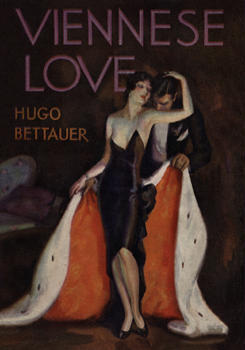
But oddly, it was Bettauer’s 1924 Die freudlose Gasse (The Joyless Street) that got him killed: an indictment of the corrupt Viennese establishment dressed up as a murder mystery. Like “crime” writer Horace McCoy’s They Shoot Horses Don’t They? or communist Guy Endore’s The Werewolf of Paris, Bettauer used the “penny-dreadful” genre as a vehicle to communicate broader universal truths to the masses, to pose uncomfortable questions and shed light on hypocrisies and social inequities. And purportedly, it was this that director and fellow Austrian G.W. Pabst saw in Bettauer’s novel as well.
For his film adaptation, Pabst ditches some of the novel’s more melodramatic elements and puts the transient presence of the “street” front and center, a dark and claustrophobic artery tenuously linking its disparate inhabitants. Pabst’s love of Bertolt Brecht is in evidence, with lives alternately shaped and destroyed by poverty and opportunity, struggles for simple sustenance juxtaposed with a crass, opulent hedonism. Greta Garbo gets her big non-Swedish break here, quickly snatched up by Hollywood shortly after the film’s release and hitting it big internationally. Even more impressive is the performance of screen veteran Asta Nielsen, who comes across as hauntingly ethereal in scenes, part mousy librarian, part powdered drag queen. Werner Krauss, who plays the butcher, is better known for being the sadistic doctor in The Cabinet of Dr. Caligari. His only requirement of Pabst was that his dog get good screen time as well. But of everyone, it’s the multi-faceted protopunk genius of dancer/actor Valeska Gert, as the owner of the brothel, that steals the show.

Very few of the silent films now considered masterpieces of the German Weimar era have the difficult history of The Joyless Street. Granted, it was not uncommon for international silent films to suffer at the hands of foreign editors. With no sound synchronization to worry about, editors and projectionists could (and did) butcher at will, deleting entire sections, rewriting intertitle cards between shots, or whatever was needed to “sanitize” a film and get it past local censors. In a couple of snips, brothels became orphanages and sex workers became volunteers for the Salvation Army (to cite two German examples, the latter from another Pabst film). The relative completeness of its German counterparts—Dr. Caligari, Nosferatu, Der Golem—reflects the fact that, much like today, horror is tolerated better than sex in the U.S. market, particularly in the 1920s when cinema was still a burgeoning industry and hypersensitive to any critiques of its morality. So a cheery Teutonic rumination on starvation, human desperation, and economic collapse was sure to bring the x-acto knives out in force. Almost immediately, 150 minutes became anywhere from 120 to 90 to 57. Some reviewers of the day could not even piece together the basic narrative. A second obstacle faced by the restorers was the lack of any existing intertitles in the original German. For the purposes of this restoration, Filmarchiv Austria recreated these using a combination of a 1926 censorship report, an early draft of the shooting script, and foreign print intertitles retranslated back into German. Its length as restored, nearly 2.5 hours, is challenging for those new to silent film; and even this is supposedly shorter than the original cuts.
Much has been written about the importance of women in The Joyless Street; see Patrice Petro’s excellent book-length study from the early 1990s. Many of Pabst films focused on women protagonists, making him one of the first feminist directors. More broadly, the film was seen as part of the “New Objectivity” movement, a rejection of the more fantastic elements of German Expressionism, its closest corollary perhaps being the Italian Neorealism of 20 years later. It also made a blazing impression on film fans in Switzerland, like poet H.D., aka Hilda Doolittle, who called it her first revelation of film as art. She wrote extensively about the experience in the feminist cinema periodical Close-Up, one of the first magazines to take the new art form seriously. Today, the film is largely forgotten in the U.S.

 Center For Cassette Studies